Bonalu 2026: Hyderabad's Great Festival of the Mother Goddess
By Divinecenter ·
If you're in Hyderabad in the month of Ashadha, something shifts in the air. The drums start first — you'll hear them before you see anything. Then the crowds arrive, and the turmeric-yellow and vermilion-red processions, the women walking in long columns with decorated pots balanced on their heads, a flame burning at the very top of each one
What is Bonalu? The Name, the Goddess, the Idea
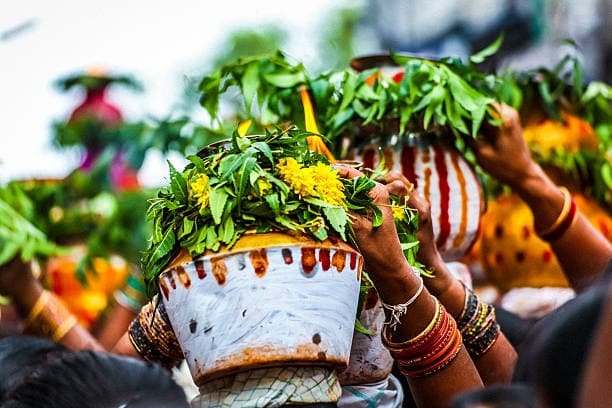
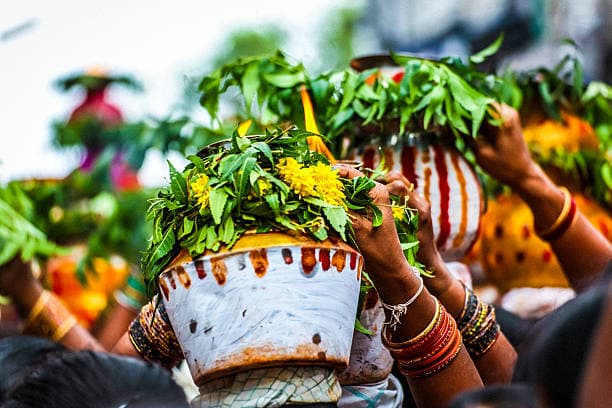
Start with the word itself. Bonalu is the Telugu plural of Bonam, which comes from the Sanskrit Bhojanam — meaning food. So at its most literal, Bonalu is a food festival. But the food isn't for people. It's an offering — cooked rice with jaggery, curd, and turmeric, prepared in a brass or earthen pot, carried on a woman's head to the temple — laid at the feet of the Mother Goddess.
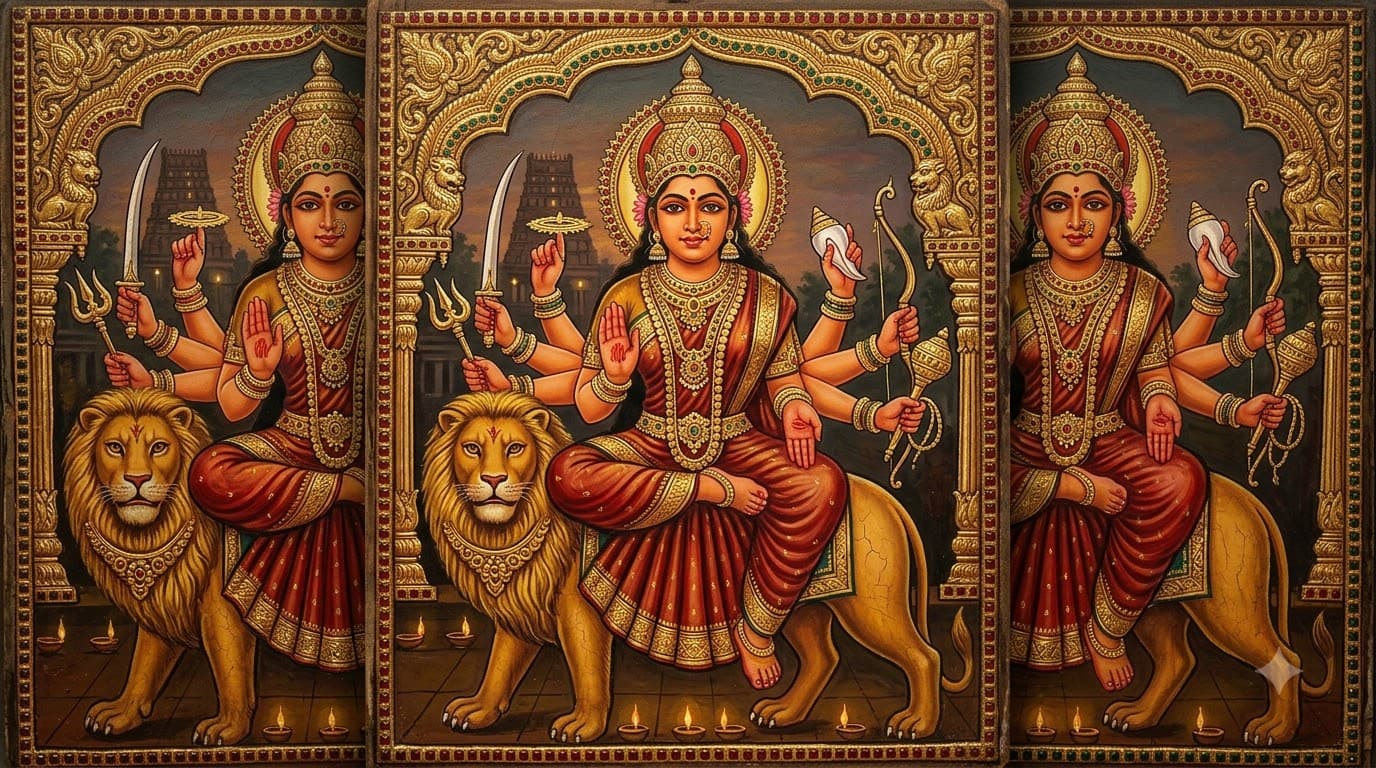
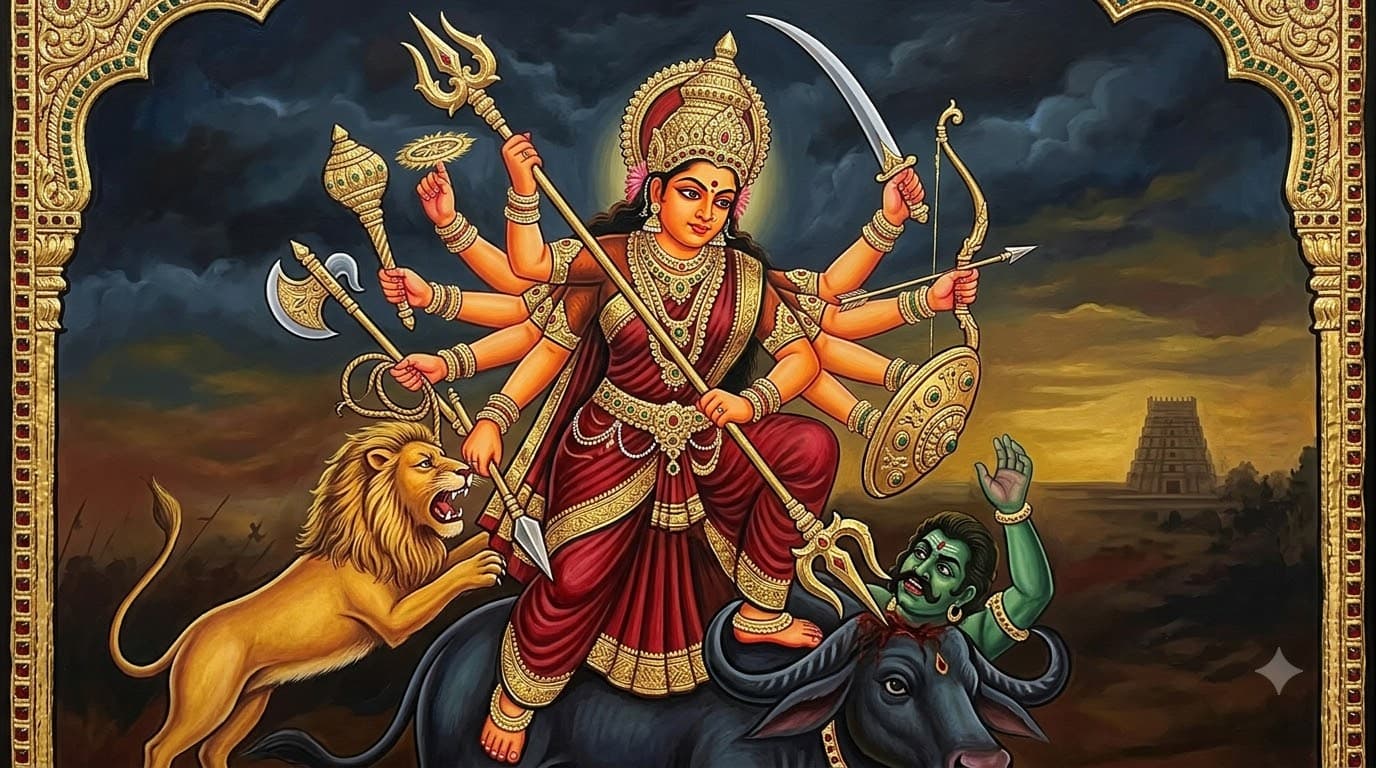
The Goddess at the centre of it all is Mahankali — the fierce, protective, all-seeing form of Shakti worshipped across Telangana under many names: Yellamma, Pochamma, Maisamma, Peddhamma, Ankalamma. Different temples, different names, but the same fundamental power: the divine mother who guards her children from disease, drought, and death.
The Telangana government formally declared Bonalu a state festival in 2014 — officially recognising what every family in Lal Darwaza and Secunderabad already knew: this festival belongs to Telangana's identity as deeply as the Telugu language itself.
The 1813 Story — How a Plague Started a Tradition
Two hundred years of Bonalu trace back to a catastrophe. In 1813, a severe plague epidemic swept through Hyderabad and Secunderabad, killing thousands. A military regiment had been stationed away from home — deployed to Ujjain, where the great Shiva temple of Mahakaleshwara stands.
When word reached the soldiers that the plague had hit their families back home, they turned to Goddess Mahankali with everything they had. They prayed. They promised: if the Goddess stops this plague and protects our families, we will build her an idol in our city and honour her every year.
The plague passed. The soldiers came home, kept their word, built the idol — and began offering Bonalu. What started as a soldier's vow in a moment of desperate prayer became a two-hundred-year tradition that outlasted every regime that came and went through Hyderabad.
There's a reason this city takes Bonalu personally.
The Festival Calendar: Four Sundays, Four Temples
Bonalu 2026 Dates:
- July 19 (Sunday) — Golconda Fort, Sri Jagadamba Mahankali Temple. The festival opens here every year, at the historic fort on the edge of the city. The Rottela Jathara procession from Langar Houz to Golconda kicks things off.
- July 26 (Sunday) — Secunderabad, Ujjaini Mahankali Temple, Regimental Bazaar. Historically where Bonalu was born — the military's temple, the soldiers' vow. The biggest Secunderabad celebrations happen here.
- August 2 (Sunday) — Old City, Matheswari Temple, Lal Darwaza. The centrepiece of the whole festival — the most concentrated, the most electric, the most photographed. Streets packed from dawn to dusk.
- August 9 (Sunday) — Final Sunday celebrations across neighbourhood temples across the twin cities.
August 3 (Monday) — Rangam at Ujjaini Mahankali Temple, Secunderabad. (More on this below.)
August 10 (Monday) — Gazetted public holiday in Telangana, marking the festival's official conclusion.
The Bonam: What the Offering Actually Looks Like
Wake up before sunrise. Take a bath. Put on fresh, clean clothes — preferably new ones. Go to the kitchen.
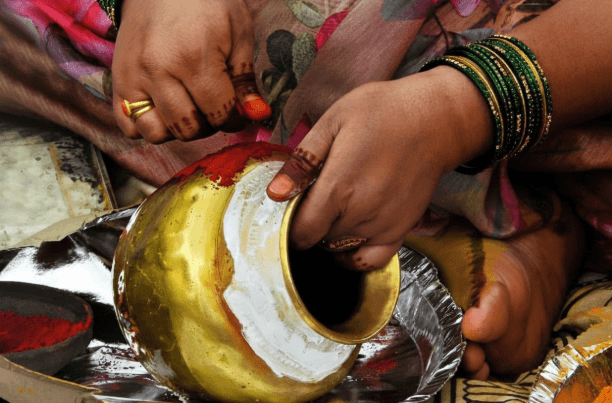
Women prepare the Bonam: rice cooked with milk, jaggery, or curd, depending on family tradition. It goes into a new brass or earthen pot — never an old one, this is the Goddess's vessel. The pot is washed, wrapped in turmeric paste and kumkum, decorated with neem leaves at the rim, and then a lit lamp is placed right at the top. The flame above the pot is the Bonam Jyoti — it should stay burning as you walk.
Then the procession begins. Women dress in traditional silk sarees, young girls in half-sarees or lehengas, and they walk — pot balanced on the head, flame burning, drums ahead — to the temple. The weight of what they're carrying is partly the pot and partly something heavier: the prayers inside it.
At the temple, the Bonam is offered to the Goddess, often along with bangles and a saree. The priest accepts it and offers it at the feet of the idol. The pot stays. The prayer goes with it.
Pothuraju — The Man Who Clears the Way
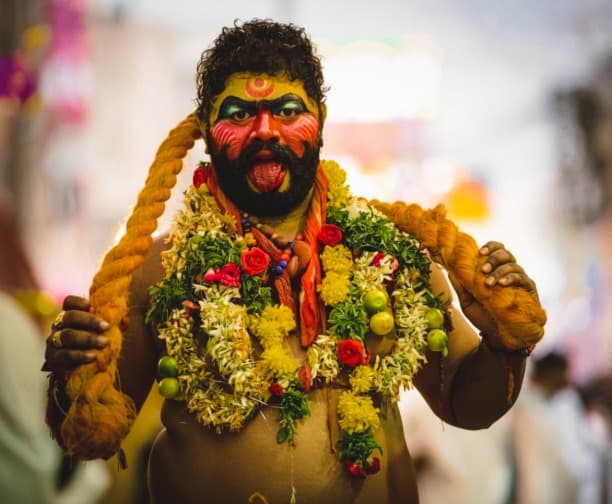
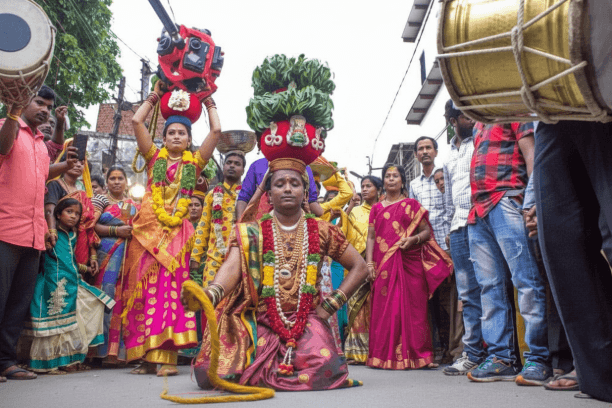
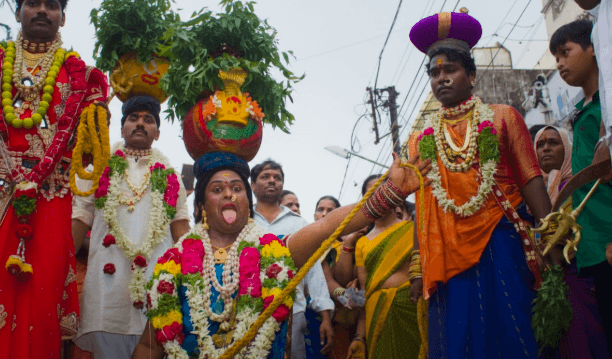
In every Bonalu procession, before the women and the pots and the devotees, there's one figure who leads the way: Pothuraju. He's a man painted in turmeric and kumkum, wielding a whip, dancing with a kind of terrifying energy to the rhythm of the drums.
Pothuraju is the divine protector of the Mother Goddess — her brother, in some traditions — and his job is to clear the path of evil and negative forces before the Goddess's devotees walk through. He lashes himself, he runs, he dances. The crowd parts around him. The drumming builds.
If you've never seen a Pothuraju in full procession, you haven't quite seen Bonalu.
Rangam — The Oracle Nobody Forgets
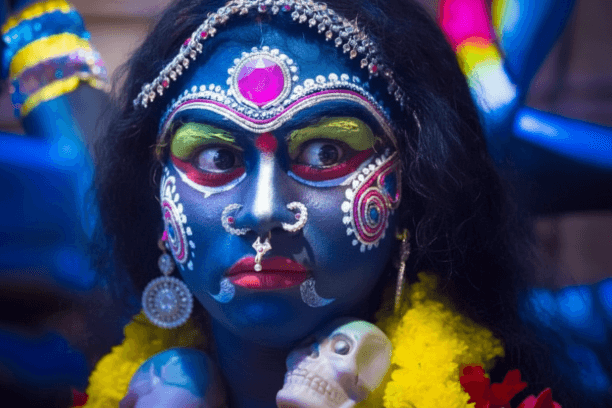
The morning after the main Lal Darwaza Bonalu — August 3, 2026 at the Ujjaini Mahankali Temple in Secunderabad — something happens that is unlike any other ritual in Hyderabad's calendar.
A woman devotee enters a trance. The belief is that the Goddess herself speaks through her. And she delivers prophecies — for the city, the state, the nation — for the coming year.
Thousands gather. People come from across the twin cities, some before dawn. There's no performance quality to it — the woman in the trance isn't acting, and the crowd watching knows it. The Rangam is simultaneously deeply religious and completely distinctive to Bonalu. Nothing else in Hyderabad's festival year looks quite like this.
Where to Experience Bonalu 2026 — And What to Know Before You Go
- Best place for first-timers: Lal Darwaza, August 2. The density, the colour, the ritual — it's the most concentrated experience.
- Best for history: Golconda Fort, July 19. The fort backdrop, the Rottela Jathara procession.
- Best for something unusual: Ujjaini Mahankali, July 26 — then return August 3 for the Rangam.
- Go early. Crowds build through the morning and the heat builds with them. By 10 AM things are packed.
- Wear comfortable footwear — you'll walk a lot, and the streets are busy.
- There's no entry fee to any of the public Bonalu celebrations or temple events. The atmosphere is welcoming.
Why Bonalu Feels Different
There are bigger festivals in India. There are older ones. But Bonalu has something specific that's hard to name: it's entirely local. It didn't come from a Puranic text or a national calendar. It came from soldiers who were afraid for their families and a city that refused to forget a promise.
The Goddess in this festival isn't remote or abstract. She's Yellamma, Pochamma, Mahankali — protective, fierce, close. The kind of Goddess you call on when things are desperate, and thank loudly when they turn out fine.
Two centuries of Hyderabad's history — Nizams, independence, statehood, everything — and Bonalu hasn't moved. That's what staying power looks like.
References & Further Reading
- StayVista — Bonalu 2026 in Hyderabad: Dates, Rituals & Where to Experience It
- ShubhDivas — Bonalu 2026: Date, Significance, Rituals
- Hindu Blog — Bonalu Jatara 2026 Dates
- Temples.bio — Bonalu 2026: Dates, Rituals & Significance
- Department of Language and Culture, Government of Telangana
Final Thoughts
Bonalu isn't a spectacle you watch from a distance. It's something the city does together — the old city's streets, the soldier's vow, the Goddess who showed up when she was needed. Show up on any of the four Sundays and you'll understand why no one in Hyderabad needs to be told twice. Jai Mahankali!
Frequently Asked Questions
Q1. When is Bonalu 2026?
A: Bonalu 2026 falls across four Sundays: July 19, July 26, August 2, and August 9. August 10, 2026 is a gazetted public holiday in Telangana to mark the festival's conclusion.
Q2. What does "Bonalu" mean?
A: Bonalu comes from the Sanskrit word Bhojanam (food), which became Bonam in Telugu — meaning the food offering made to the Mother Goddess. Bonalu is the plural: the many offerings carried to the goddess across the festival.
Q3. Where does Bonalu start in Hyderabad?
A: The festival opens every year at the Sri Jagadamba Mahankali Temple at Golconda Fort on the first Sunday of Ashadha — July 19 in 2026. The Rottela Jathara procession from Langar Houz to Golconda kicks things off.
Q4. Which is the main temple for Bonalu 2026?
A: The centrepiece is the Matheswari Temple at Lal Darwaza in the Old City on August 2. The Ujjaini Mahankali Temple in Secunderabad (historically the festival's birthplace) and the Golconda Fort temple are equally significant.
Q5. What is Rangam in Bonalu?
A: Rangam is a prophecy ritual unique to Bonalu. A woman devotee enters a trance believed to be the Goddess speaking through her, and delivers predictions for the coming year. In 2026, Rangam takes place on August 3 at Ujjaini Mahankali Temple in Secunderabad.
Q6. Who is Pothuraju?
A: Pothuraju is the divine male protector of the Mother Goddess — often described as her brother. During Bonalu processions, a man ritually embodies Pothuraju: painted in turmeric and kumkum, wielding a whip, dancing to drums ahead of the devotees.
Q7. Is Bonalu only celebrated in Hyderabad?
A: Bonalu is celebrated across Telangana — in Warangal, Nizamabad, Karimnagar, Khammam and many districts. But Hyderabad and Secunderabad remain the spiritual and cultural heart of the festival, with the main temple sequence and the Rangam ritual.
Q8. Is there an entry fee for Bonalu?
A: No. General participation in Bonalu processions and temple visits is free for everyone.
Q9. What should I wear to Bonalu?
A: There is no strict dress code. Comfortable footwear is important — crowds are large and you will walk a lot. Traditional attire is appreciated as a mark of respect. Arrive early to avoid peak heat and the largest crowds.
Q10. Can I arrange a Mahakali puja at home for Bonalu?
A: Yes. Divine Center connects you with verified pandits across Hyderabad for Mahakali puja, Chandi Homa, Devi Archana and other Shakti rituals at home or online — with no login required to make an enquiry.