Bathukamma — Telangana's Flower Song to the Goddess
By Divine center ·
Bathukamma 2026 runs October 10-18 in Telangana. Here's the story behind the festival, all nine days explained, and how any household can make one at home.
Bathukamma
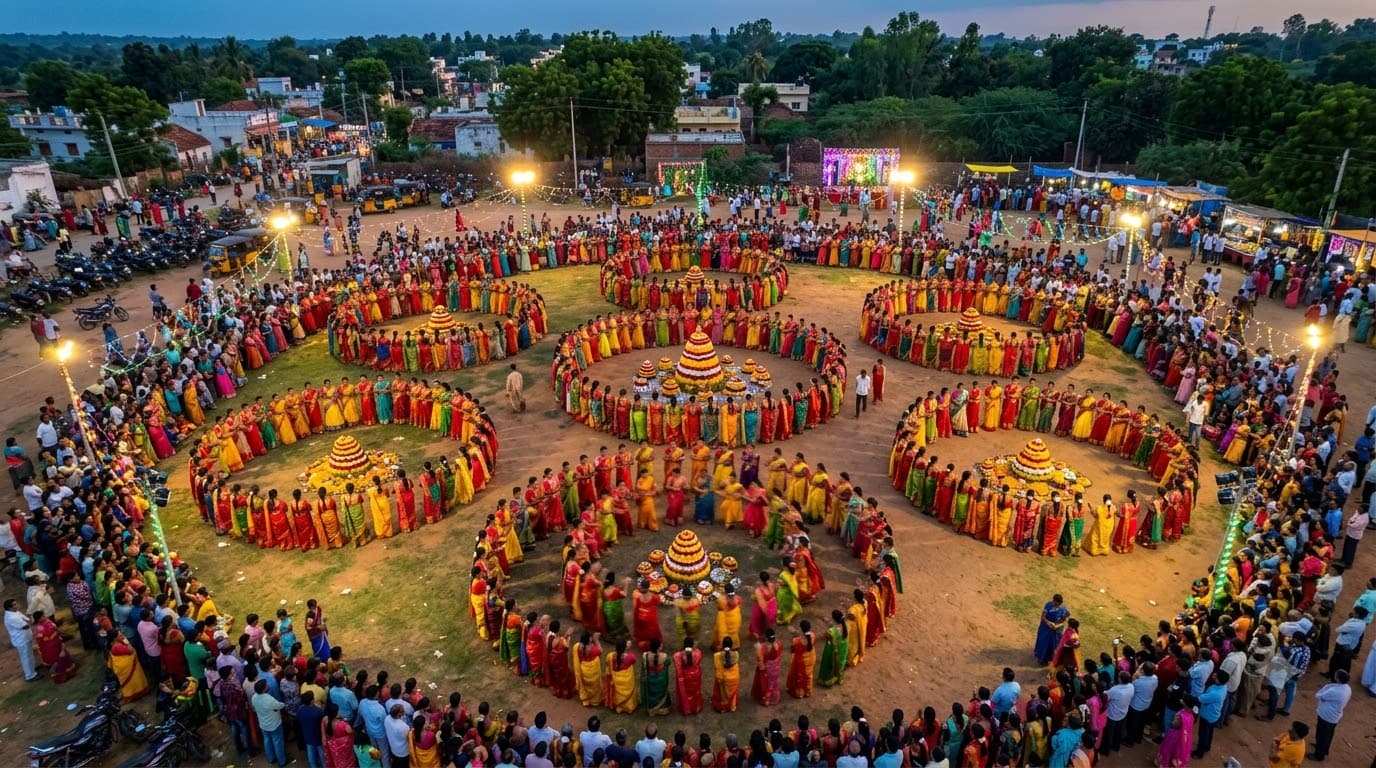
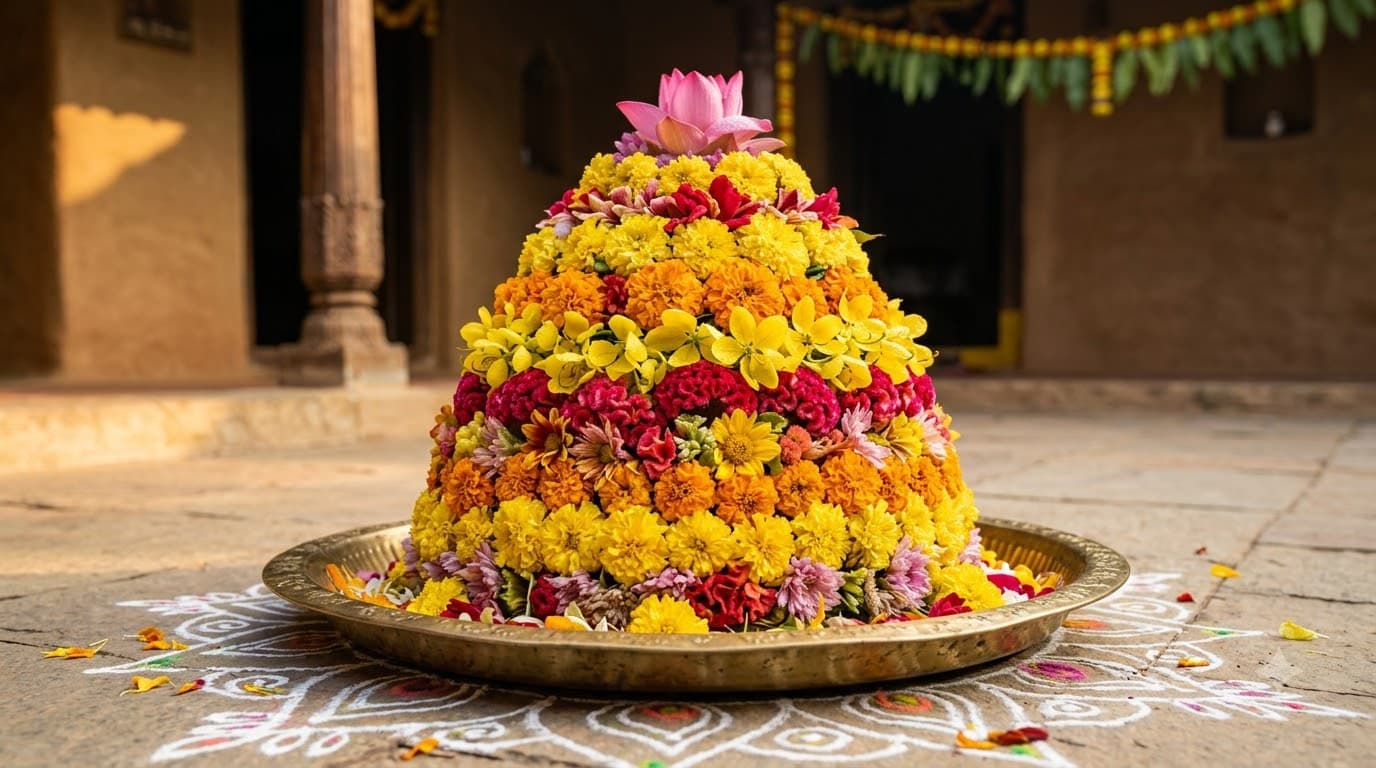
Just before sunset, the flowers come out of every house on the street at once. Tangedu, Gunuka, Banthi, Chamanti — whatever's blooming that week — stacked in careful rings on a brass plate until they form a small, bright cone. Then the women and girls of the colony gather in a circle around them, clap, and start singing. There's no priest, no idol in the usual sense, and no havan smoke. Just flowers, voices, and a goddess who, tradition says, is called back to life one petal at a time.
This guide walks through what Bathukamma actually is, why it's celebrated the way it is, the exact 2026 dates for all nine days, and how families in and around Hyderabad observe it.
1. What Is Bathukamma?
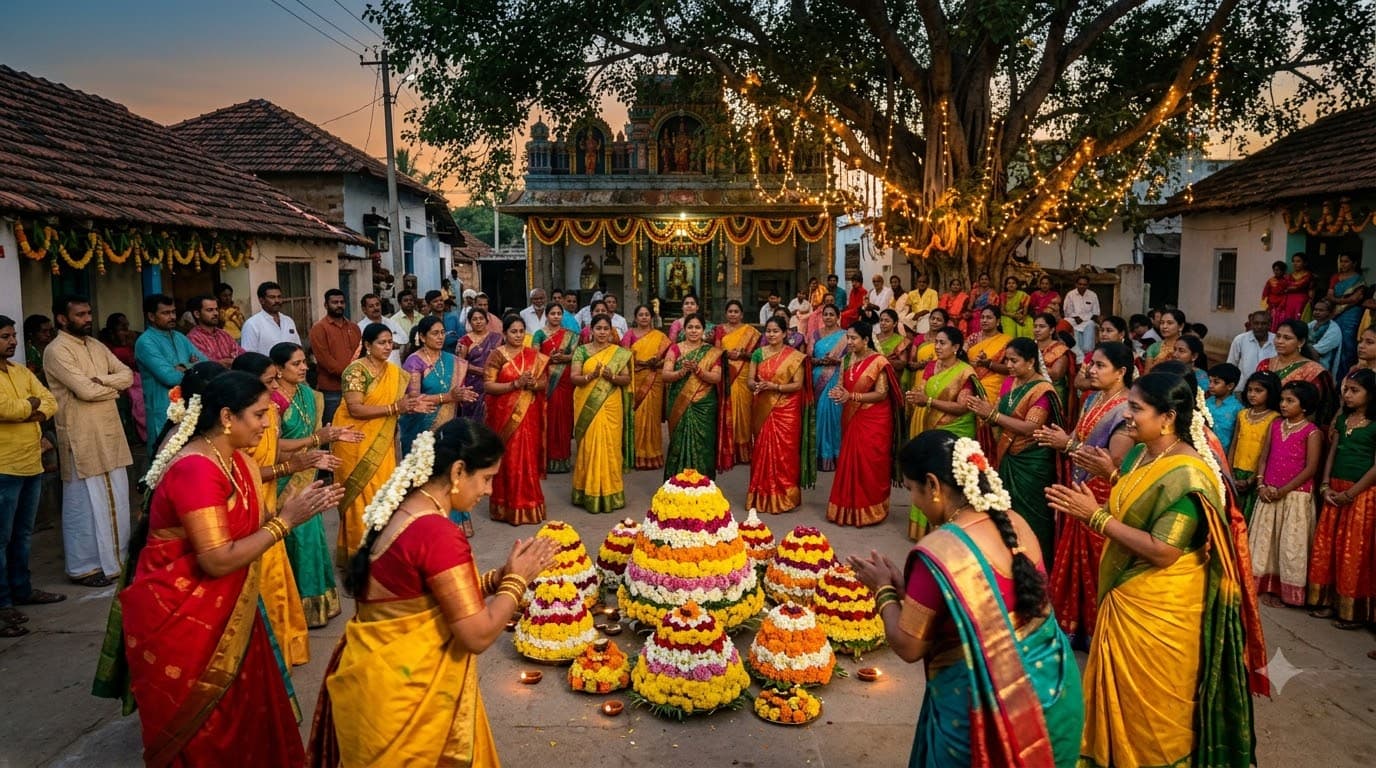
Bathukamma is Telangana's own floral festival, celebrated over nine days during Ashwayuja Masam, running almost exactly alongside Sharad Navratri. The name itself comes from Telugu — “Bathukamma” roughly translates to “Mother, come alive,” and the whole festival centers on building a stacked, flower-only representation of Goddess Gauri each evening, singing around it, and finally immersing it in a lake or pond on the last day.
Unlike most Hindu festivals built around an idol and a pandit-led puja, Bathukamma is led almost entirely by women and girls at home, using whatever seasonal flowers are available — Tangedu (Tanner's cassia), Gunuka (globe amaranth), Banthi (marigold), and Chamanti (chrysanthemum) among the most common.
At a Glance:
- 2026 dates: Saturday, October 10 to Sunday, October 18, 2026 — nine days
- Begins on: Engili Pula Bathukamma, on Mahalaya Amavasya
- Ends on: Saddula (Pedda) Bathukamma, the festival's finale
- Deity honored: Goddess Gauri (Bathukamma), a form of the mother goddess
- Region: Telangana, with strong presence in Hyderabad, Warangal, and across the state
- Calendar system: Ashwayuja Masam per the Telugu (Amanta) panchangam observed in Telangana
Did You Know? Bathukamma falls in almost the exact same window as Navratri and Dussehra every year, but it isn't the same festival — it's Telangana's own, separate tradition that simply shares the season.
2. Why Is Bathukamma Celebrated?
There are a few different stories families tell about how Bathukamma began, and most households aren't particular about picking just one. One widely told version holds that Goddess Lakshmi, born to a royal couple and later troubled by repeated hardships, was finally revived by the prayers and songs of women who gathered around her with flowers — and that the festival re-enacts that moment of the goddess “waking up” each year. Another version ties Bathukamma to the earth goddess Gauri and older agricultural worship, timed to the season when the first flowers of Ashwayuja Masam bloom after the monsoon.
A common mix-up:
- Myth: Bathukamma is simply a smaller, regional version of Navratri. Fact: it is its own distinct tradition with different rituals, songs, and a goddess form (Bathukamma/Gauri) worshipped without an idol, even though the two festivals overlap in timing.
- Myth: Any flowers can be used interchangeably. Fact: certain flowers — especially Tangedu — carry specific ritual importance in the tradition and are used on particular days of the nine, not just for decoration.
- Myth: Bathukamma requires a priest to be performed correctly. Fact: it is traditionally led by women of the household and community, with no pandit involved in the core ritual — a genuine folk tradition rather than a Vedic one.
This account is part of Telangana's oral and folk tradition rather than a single documented origin — families pass down whichever version their own elders taught them, and that variation is part of what keeps the festival alive.
3. Complete Date & Ritual Calendar
These dates follow the Telugu (Amanta) panchangam observed in Telangana, cross-checked against Telangana-specific festival listings rather than a generic pan-India calendar.
- Day 1 — Engili Pula Bathukamma: Saturday, October 10, 2026 (Mahalaya Amavasya)
- Day 2 — Atkula Bathukamma: Sunday, October 11, 2026
- Day 3 — Muddapappu Bathukamma: Monday, October 12, 2026
- Day 4 — Nanabiyyam Bathukamma: Tuesday, October 13, 2026
- Day 5 — Atla Bathukamma: Wednesday, October 14, 2026
- Day 6 — Aligina Bathukamma: Thursday, October 15, 2026
- Day 7 — Vepakayala Bathukamma: Friday, October 16, 2026
- Day 8 — Vennamuddala Bathukamma: Saturday, October 17, 2026
- Day 9 — Saddula (Pedda) Bathukamma: Sunday, October 18, 2026
Panchangam Note: Saddula Bathukamma coincides with Durgashtami as observed in Telangana. Some pan-India panchangams place Durga Ashtami a day later, on October 19 — this is a regional tithi variation, not an error on either side. The Telangana government's own festival calendar treats October 18 as Saddula Bathukamma.
A caution worth keeping in mind: as with any tithi-based date, timings are reckoned from local sunrise and can shift by a day between panchangams. If your family follows a specific local tradition for when each of the nine days falls, that local reckoning takes precedence — this calendar reflects the commonly followed Telangana sequence.
4. Where Is Bathukamma Observed?
Bathukamma is celebrated across Telangana, but it's genuinely a neighborhood-level festival rather than a temple-centered one — most of it happens on the street, in a colony courtyard, or beside a local pond, not inside a shrine. In Hyderabad, the best-known public gathering happens at Tank Bund, where the state government has organized large official Bathukamma celebrations in recent years, alongside smaller gatherings at LB Stadium and lakes across the city.
Every basti and colony tends to have its own smaller version — a patch of open ground or a temple courtyard where the women of that street gather each evening. Telangana households living outside the state, including in Bengaluru, Chennai, and abroad, have also kept the tradition going through community associations, often adapting the final immersion to whatever water body is locally accessible.
5. Spiritual Significance
At its core, Bathukamma is a festival of the feminine and of nature together — women gathering flowers grown in the post-monsoon season and shaping them into a form of the goddess is treated as an act of both devotion and renewal. There is no murti in the conventional sense; the flowers themselves are the deity for the length of the festival, worshipped, sung to, and then returned to the water they came from.
Many families see the nine days as mirroring Navratri's own arc of gathering strength before a culmination, even though the two traditions are separate. The final immersion on Saddula Bathukamma is treated less as an ending than as a return — the goddess going back into the water she'll be gathered from again as flowers next year.
6. How to Make a Bathukamma at Home
You don't need many materials to take part — most families put theirs together from whatever's in bloom that day and a plate from the kitchen:
- Base tray: a wide brass or steel plate (tambalam), sometimes lined with banana leaf.
- Flowers: concentric rings of Tangedu, Gunuka, Banthi, and Chamanti, arranged largest at the base and narrowing upward into a cone shape.
- Turmeric Gauri: a small turmeric or clay Gowramma figure placed on top of the finished flower stack.
- Evening gathering: the Bathukamma is carried out at dusk, placed in the center of a circle, and women and girls clap and sing traditional songs while circling it.
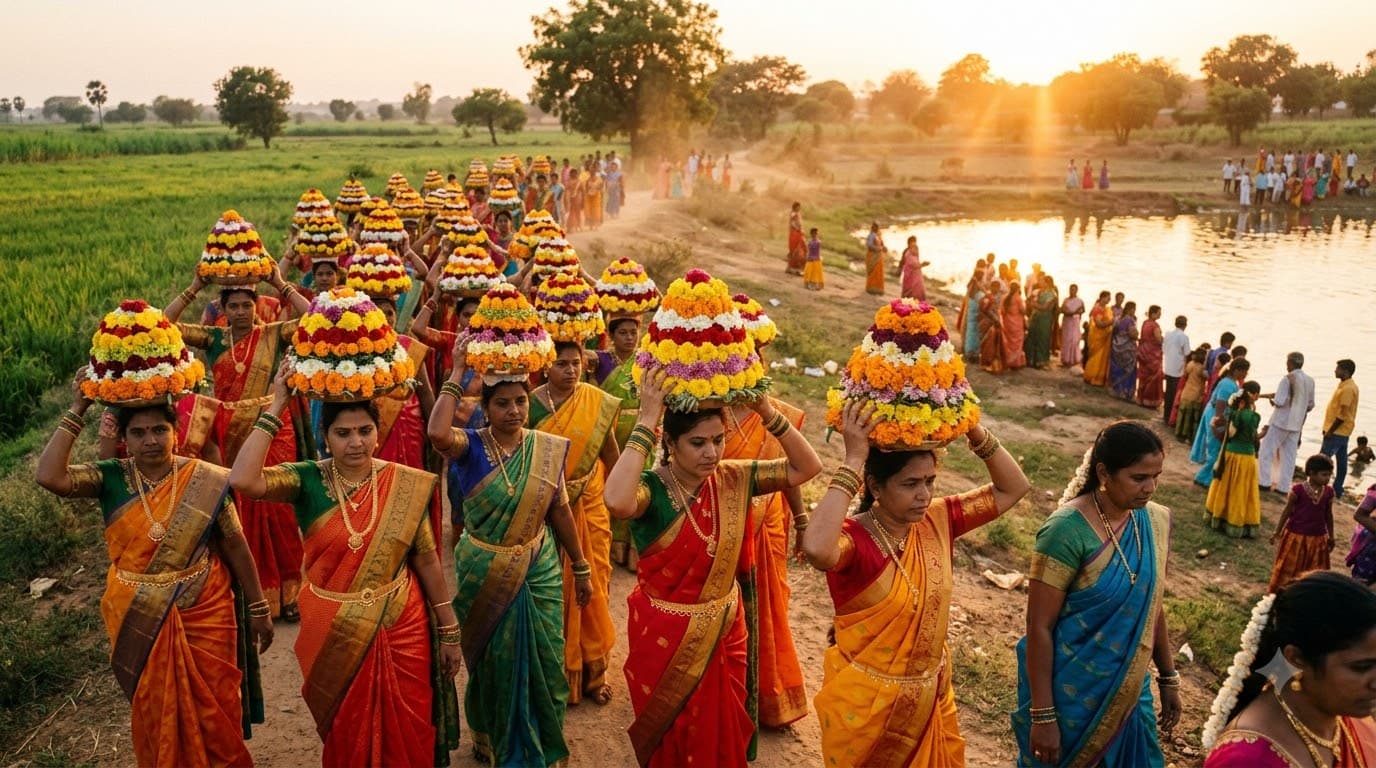
- Closing: on the final day, the flowers are carried to a lake, pond, or any accessible water body for immersion, followed by an exchange of Bathukamma prasadam among the group.
Quick Tip: If Tangedu or Gunuka flowers aren't available where you live, most families simply substitute whatever seasonal flowers they can find — the intention and the singing matter more than an exact botanical match.
7. The Nine Days of Bathukamma
Each of the nine days has its own name and its own small food offering, usually tied to what's traditionally prepared and shared that evening:
- Engili Pula Bathukamma (Day 1): a modest beginning, often with a simple offering of nune biyyam (rice soaked in oil) and Nuvvulu (sesame).
- Atkula Bathukamma (Day 2): flattened rice (Atukulu) mixed with jaggery is the day's naivedyam.
- Muddapappu Bathukamma (Day 3): offered with Muddapappu (mashed lentils) and pulihora (tamarind rice).
- Nanabiyyam Bathukamma (Day 4): soaked rice mixed with milk and jaggery.
- Atla Bathukamma (Day 5): Dosa or Atlu shared as prasadam.
- Aligina Bathukamma (Day 6): traditionally a quieter day, sometimes without a Bathukamma made at all in some families.
- Vepakayala Bathukamma (Day 7): sweet, deep-fried Vepakaya-shaped snacks shared among neighbors.
- Vennamuddala Bathukamma (Day 8): butter and jaggery offered together as naivedyam.
- Saddula (Pedda) Bathukamma (Day 9): the grand finale, with Sakinalu, Nemili Kura, Sakalu, and other festive dishes prepared, followed by the largest gatherings and the immersion.
8. Bathukamma Naivedyam & Community Customs
Bathukamma isn't a fasting festival — there are no dietary restrictions attached to it the way there are for some Navratri observances. What it does carry, strongly, is a daily food-sharing custom: each day's naivedyam is prepared, offered briefly to the Bathukamma, and then distributed among the women and children who gathered for that evening's singing. Many colonies treat this as the social heart of the festival — as much a chance to catch up with neighbors as it is a ritual.
On Saddula Bathukamma especially, it's common for extended family to visit, for married daughters to return to their parents' home if possible, and for the day's spread of food to be considerably larger than the earlier eight.
9. Do's and Don'ts for Bathukamma
Do:
- Use whatever seasonal, locally available flowers you can find if traditional ones like Tangedu aren't accessible.
- Take part in your local colony or community gathering if one is organized — Bathukamma is meant to be communal.
- Learn a few of the traditional songs, even simplified versions — singing is as central to the festival as the flowers themselves.
- Immerse the flowers in a clean water body, or use a small tub of water at home if a lake or pond isn't accessible.
Don't:
- Don't treat Bathukamma as identical to Navratri when explaining it to others — the two are separate traditions that happen to overlap.
- Don't use plastic flowers or synthetic decorations for the immersion — it defeats the biodegradable, nature-honoring spirit of the ritual.
- Don't skip the singing and gathering aspect — the flower arrangement alone is only part of the observance.
10. Interesting Facts About Bathukamma
- The Telangana government has organized large-scale official Bathukamma celebrations at Hyderabad's Tank Bund, drawing thousands of participants in a single evening.
- Bathukamma is recognized as one of Telangana's defining cultural festivals and carries its own dedicated public holiday in the state.
- The word Bathukamma is believed to derive from “Bathuku” (life) and “Amma” (mother) — together read as an invocation for the mother goddess to “come alive” or grant life.
- Unlike most major Hindu festivals, Bathukamma has no fixed idol, no fire ritual, and traditionally no priest — it is led entirely by women.
- Telangana diaspora communities across India and abroad continue to organize their own Bathukamma gatherings, often adapting the final immersion to a locally available water source.
11. Book Your Dasara Season Pujas with Divine Center
Bathukamma week is also Navratri season — planning Ghatasthapana, Ayudha Puja, or Saraswati Puja alongside it? Book Navratri Ghatasthapana Puja | Talk to Our Priest | Contact Divine Center
13. References & Further Reading
- Bathukamma — Wikipedia — background on the festival's history, legends, and cultural recognition.
- Saddula Bathukamma 2026, Telangana — Office Holidays — the Telangana-specific source used for this year's Saddula Bathukamma date.
- Mahalaya Amavasya 2026 Date — HinduTone — used to confirm the 2026 start date (Engili Pula Bathukamma) against Mahalaya Amavasya.
14. Final Thoughts
Nine days is a short window, but by the time Saddula Bathukamma arrives, it's changed the texture of an entire colony — flowers on every doorstep, songs carrying between houses, and a lake or pond that's briefly, beautifully, covered in color. It's a festival that asks very little in the way of ritual correctness and a great deal in the way of showing up — gathering the flowers, joining the circle, singing even if you don't remember every word.
Bathukamma jarupukondi, Shubhamastu.
Frequently Asked Questions
Q1. What does the word Bathukamma mean?
Bathukamma is generally understood to come from Telugu “Bathuku” (life) and “Amma” (mother), together invoking the mother goddess to come alive or grant life — matching the festival's central act of building and then reviving a flower form of the goddess.
Q2. What are the Bathukamma 2026 dates?
Bathukamma runs for nine days from Saturday, October 10 to Sunday, October 18, 2026, beginning with Engili Pula Bathukamma on Mahalaya Amavasya and ending with Saddula (Pedda) Bathukamma.
Q3. Is Bathukamma the same as Dussehra or Navratri?
No. Bathukamma is a separate, Telangana-specific tradition honoring Goddess Gauri through flowers, while Dussehra/Navratri is the pan-Indian festival tied to Durga and Rama. They fall in the same season and often overlap by a day or two, but they are distinct observances.
Q4. Do I need a priest to celebrate Bathukamma?
No. Bathukamma is traditionally led by the women of the household and community without a pandit — it's one of the few major festivals in this tradition performed entirely outside the usual priest-led puja format.
Q5. What flowers are used to make a Bathukamma?
Tangedu, Gunuka, Banthi (marigold), and Chamanti (chrysanthemum) are among the most commonly used, though families substitute whatever seasonal flowers are locally available.
Q6. Why does Saddula Bathukamma's date sometimes look different across sources?
It coincides with Durgashtami, which itself can shift by a day between panchangams depending on regional tithi calculations. Telangana's own festival calendar places Saddula Bathukamma on October 18, 2026.
Q7. Is Bathukamma a public holiday in Telangana?
Yes, Saddula Bathukamma is observed as a regional holiday in Telangana, reflecting the festival's status as one of the state's defining cultural celebrations.
Q8. Can Bathukamma be celebrated outside Telangana?
Yes — Telangana communities in other Indian cities and abroad regularly organize their own Bathukamma gatherings, usually adapting the final immersion step to whatever water body is locally accessible.