Saraswati Devi: Navratri Day 7 2026 — Date & Puja Guide
By Divine center ·
Saraswati Devi, goddess of knowledge, music, and the arts, is honored on Day 7 of Navratri 2026 (Oct 17) as Saraswati Puja. Here's her significance, iconography, and how to observe her day at home.
1. Who Is Saraswati Devi?
Saraswati Devi is the goddess of knowledge, learning, music, and the arts, honored on the seventh day of Navratri. Her name is generally read as coming from saras (flow) and vati (one who possesses) — “she who flows,” an image tied to both a river and to speech, learning, and creative expression flowing through a person.
This day, observed within Navratri as Saraswati Puja, is when Telugu households traditionally set aside their books, notebooks, and musical instruments as an offering, asking for her blessing on the year of learning and creative work ahead. Devi Triratra Vratam, a three-night observance leading into the festival's final days, also begins on this date in many households.
At a Glance:
- Name meaning: Saras (flow) + vati (one who possesses) — “she who flows,” an image tied to speech, learning, and creativity
- Navratri day: Day 7 of 9
- 2026 date: Saturday, October 17, 2026 (Hyderabad/Telangana) — observed as Saraswati Puja
- Mount (vahana): Swan (hamsa), sometimes shown with a peacock
- Known for: knowledge, music, the arts, and speech; books and instruments are traditionally set aside for her blessing on this day
Did You Know? Saraswati is one of the Tridevi, worshipped alongside Lakshmi and Parvati as one of the three principal goddesses in the Hindu tradition — while Lakshmi represents wealth and Parvati represents power, Saraswati represents knowledge and wisdom.
2. Saraswati Devi and the Tradition of Vidya
Unlike an origin story tied to a specific demon or battle, Saraswati's place in the Puranic tradition is broader: she is described as the goddess who gave Brahma, the creator, the power of speech and articulate thought, without which creation itself could not be communicated or understood. In that reading, her worship isn't one stage in a sequence so much as the foundation underneath all learning, art, and speech that the rest of Navratri's observances depend on.
Her worship within this stretch of the festival (Saraswati Puja on Day 7, alongside the start of Devi Triratra Vratam in many Telugu households) is generally treated as a season for turning attention specifically toward study and the arts. It's worth noting this as living devotional tradition and regional custom, carried forward through practice rather than a single settled textual account.
3. Iconography & Symbolism
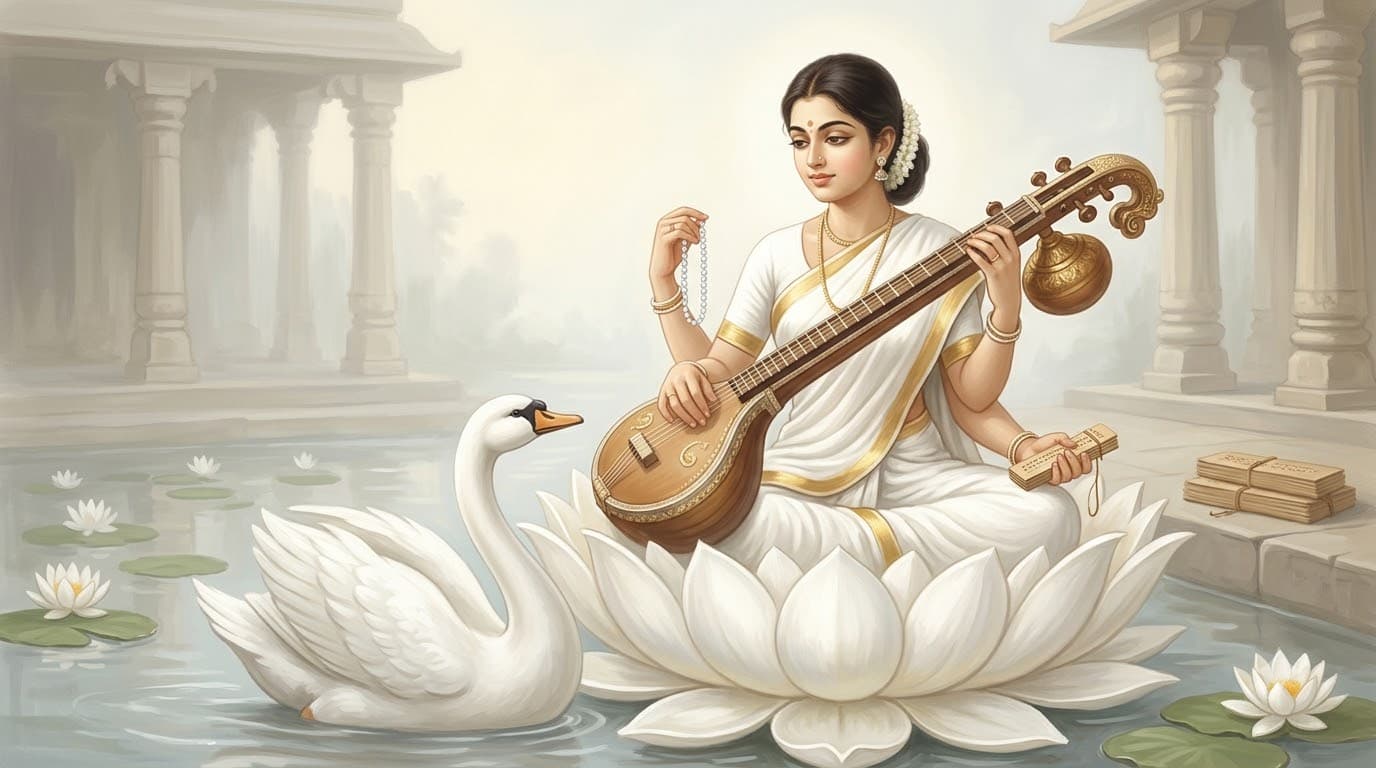
Saraswati Devi's imagery is built entirely around clarity, learning, and the arts:
- Complexion & attire: typically shown in pure white, reflecting purity and the clarity of true knowledge.
- Veena: almost always shown holding a veena, representing music and the arts.
- Book (pustaka): usually held in one hand, representing knowledge and scripture.
- Rosary (akshamala): held in another hand, representing meditation and spiritual discipline.
- Water pot (kamandalu): sometimes shown, representing purifying knowledge.
- Mount: a swan (hamsa), sometimes a peacock — the swan traditionally read as a symbol of discernment, said in folklore to separate milk from water.
Every element points the same direction: toward learning approached with discipline and purity. There's no fierce or destructive symbolism in her iconography at all — she's one of the more consistently serene and composed deities honored during this period.
4. When Is Saraswati Devi Worshipped in 2026?
Saraswati Devi is honored on the seventh day of Navratri, which falls on Saturday, October 17, 2026 in Hyderabad and across Telangana, corresponding to Ashwin Shukla Saptami — the seventh tithi of the bright fortnight. This is the day widely observed as Saraswati Puja.
These dates follow the Telugu (Amanta) panchangam observed in Telangana and Andhra Pradesh, verified against a Hyderabad-set calendar rather than a generic or North-India-default source.
A caution worth keeping in mind: tithi timings are reckoned from local sunrise and can shift by a day between panchangams, or for readers outside India. If you're timing a specific puja, it's worth confirming with a local panchangam or your pandit rather than a single online source.
5. Spiritual Significance
Devotion to Saraswati Devi is tied to learning approached with humility — the idea that knowledge, music, and creative skill are gifts to be asked for and cared for, not simply owned once acquired. Many households treat this specifically as a day to pause and be grateful for the tools of study and craft rather than push through them.
Students preparing for exams, musicians, writers, and anyone whose work depends on skill or study often turn to this day specifically, setting their books, instruments, or tools of trade before the goddess and asking for clarity and discipline in the year ahead rather than for a shortcut past the work itself.
6. How to Worship Saraswati Devi at Home
A Saraswati puja at home is simple and centers on the books and instruments themselves rather than elaborate ritual:
- Cleanse the puja space: a simple wipe-down and a lit diya is enough.
- Gather books and instruments: place notebooks, schoolbooks, musical instruments, and any tools of a creative trade near the altar as an offering.
- Offer white or yellow flowers: along with kumkum and akshata (turmeric-coated rice).
- Set the tools aside for the day: many households avoid studying, writing, or playing an instrument on this day, treating the pause itself as part of the offering.
- Chant or recite: her name and dedicated verses (see Section 7) with attention rather than speed.
- Offer naivedyam: see Section 8 for what's traditionally offered.
Quick Tip: If keeping every book and instrument aside for a full day isn't practical, even placing a single notebook or instrument near the altar for the puja itself is considered a meaningful gesture — the intent matters more than the scale.
7. Mantras & Chants
Saraswati Devi's widely recited beej mantra is:
“Om Aim Saraswatyai Namah”
This is chanted repeatedly, often 108 times with a mala, as part of her dedicated puja. The verse “Ya Kundendu Tushara Haaradhavalaa”, a well-known Sanskrit shloka describing her seated on a white lotus, is also widely recited in temples and by students during this period. If you're not certain of the exact Sanskrit, a simple, sincere repetition of the beej mantra above, combined with her name, is considered sufficient for home worship — there's no need to reconstruct verses from memory.
8. Bhog & Naivedyam
White or light-colored sweets — kheer, or dishes made with milk — are the naivedyam most commonly offered on Saraswati Devi's day, in keeping with her association with purity and clarity.
Beyond that general pattern, there isn't a single, strongly established regional dish tied exclusively to this day the way some other Navratri observances have — it's worth saying that plainly rather than inventing a more elaborate food tradition. Many households simply continue whatever naivedyam pattern they're following for the rest of Navratri and add a simple white sweet specifically for this day.
9. Do's and Don'ts
Do:
- Keep books and instruments near the altar, even if only for the day of the puja itself.
- Offer white or yellow flowers if you're following that specific convention.
- Keep the chanting unhurried; a shorter, focused recitation is considered better than a rushed longer one.
- Offer a simple white sweet as naivedyam if that's part of your family's practice.
Don't:
- Don't feel you need an elaborate ritual — Saraswati puja is traditionally one of the simpler observances within Navratri.
- Don't worry if avoiding books and instruments for a full day isn't practical for work or school commitments; a brief pause and offering is considered meaningful on its own.
- Don't skip acknowledging musical instruments if your household owns any — they're as central to this day's puja as books are.
10. Interesting Facts About Saraswati Devi
- Saraswati is one of the Tridevi, worshipped alongside Lakshmi and Parvati as one of the three principal goddesses in the Hindu tradition.
- In South Indian tradition, she is also known as Sharada, honored especially at the Sharada Peetham in Sringeri — a name many associate with the autumn season (Sharad) in which this Navratri observance falls.
- The swan, her most common mount, is traditionally read as a symbol of discernment — said in folklore to separate milk from water, much as clear knowledge separates truth from confusion.
- Saraswati Puja on this day is observed as a distinct, standalone tradition within Navratri, separate from the region's general Devi worship carried through the rest of the festival.
- Students, musicians, and writers across India observe versions of Saraswati worship at multiple points in the year — Vasant Panchami in spring is the other major occasion — making her one of the most continuously honored deities associated with learning.
13. References & Further Reading
- Saraswati — Wikipedia — background on Saraswati's role as the goddess of knowledge, music, and the arts.
- Navaratri — Wikipedia — overview of the nine-night festival and how it's observed across regions.
- Navratri Day 7 (Saptami) 2026 Date & Time, Hyderabad — DrikPanchang — the Hyderabad-specific panchangam source used for this year's Saptami date.
14. Final Thoughts
Day seven asks something quieter of a household than the fiercer turns other days of Navratri take — not spectacle, but gratitude for the ability to learn, create, and express in the first place. Setting a book or an instrument down at Saraswati Devi's feet, even briefly, is really just a way of remembering where that ability comes from.
Shubham.
Frequently Asked Questions
Q1. Who is Saraswati Devi and why is she worshipped on Day 7 of Navratri?
Saraswati Devi is the goddess of knowledge, music, and the arts, honored on the seventh day of Navratri as Saraswati Puja. Books, notebooks, and musical instruments are traditionally set aside at her feet on this day as households ask for her blessing on learning and creative work.
Q2. What is the date for Saraswati Puja in 2026?
Saraswati Devi is worshipped on Saturday, October 17, 2026, in Hyderabad and Telangana, corresponding to Ashwin Shukla Saptami per the Telugu (Amanta) panchangam.
Q3. What does the name Saraswati mean?
Saraswati is generally read as combining saras (flow) and vati (one who possesses) — “she who flows,” an image connected to a river as well as to speech, learning, and creativity flowing through a person.
Q4. Is Saraswati Puja on Navratri Day 7 the same as Saraswati worship on Vasant Panchami?
They honor the same goddess but are separate occasions on the calendar. Vasant Panchami, in spring, is the major pan-India Saraswati festival, while this Navratri-period Saraswati Puja is a Telugu Navratri custom observed specifically on the festival's seventh day.
Q5. What is Saraswati Devi's mantra?
Her widely recited beej mantra is “Om Aim Saraswatyai Namah,” typically chanted 108 times with a mala. The shloka “Ya Kundendu Tushara Haaradhavalaa” is also commonly recited during this period.
Q6. What is offered as naivedyam to Saraswati Devi?
White or light-colored sweets, often kheer or milk-based dishes, are commonly offered, in keeping with her association with purity. There isn't one single elaborate dish uniquely tied to this day beyond that general pattern.
Q7. Why are books and musical instruments kept near the altar on this day?
Books, notebooks, and instruments are treated as an offering on Saraswati Devi's day — many households avoid using them for the day, setting them at her feet instead as a gesture of gratitude for the ability to learn and create.
Q8. Is Saraswati Devi the same as the Sharada worshipped in South India?
Yes — Sharada is the name by which Saraswati is widely known and worshipped in South Indian tradition, notably at the Sharada Peetham in Sringeri; it refers to the same goddess of knowledge and the arts honored during Navratri.