Mahishasuramardini Devi: Navratri Day 9 2026 — Date & Puja Guide
By Divine center ·
Mahishasuramardini Devi, worshipped on Day 9 of Navratri 2026 (Maha Navami, Oct 19), is Durga in her climactic form as slayer of the buffalo demon Mahishasura. Here's her legend, iconography, and how the day closes into Dasara.
1. Who Is Mahishasuramardini Devi?
Mahishasuramardini Devi is worshipped on Maha Navami, the last day of active Navratri puja before Vijayadashami. Her name combines Mahishasura — the buffalo demon of the Puranic tradition — and mardini (she who crushes or slays), together meaning “she who slew Mahishasura.”
Where the earlier days of Navratri build up different qualities of the goddess — devotion, motherhood, learning, strength — Maha Navami is the day tradition points directly to the climax of her best-known legend: the battle in which she ended the reign of a demon no god could defeat alone.
At a Glance:
- Name meaning: Mahishasura (the buffalo demon) + mardini (she who crushes/slays) — “she who slew Mahishasura”
- Navratri day: Day 9 of 9 (Maha Navami)
- 2026 date: Monday, October 19, 2026 (Hyderabad/Telangana)
- Mount (vahana): Lion
- Known for: the climactic slaying of the buffalo demon Mahishasura; marks the final day of active Navratri worship
Did You Know? Mahishasuramardini is one of the most widely depicted forms of the goddess in Indian temple art and sculpture, appearing in reliefs and idols across the country that are centuries old, independent of the specific Navratri worship calendar.
2. The Legend of Mahishasuramardini Devi
The legend at the center of this day comes from the Devi Mahatmyam: the buffalo demon Mahishasura had won a boon that no man or god could kill him, and used that near-invincibility to terrorize the heavens and the earth. Unable to defeat him individually, the gods are said to have combined their own energies into a single, unified force — Durga — arming her with a weapon from each of their own arsenals: Shiva's trident, Vishnu's discus, Indra's thunderbolt, and more.
The battle that followed is described as fierce and prolonged, with Mahishasura repeatedly changing form — buffalo, lion, elephant, man — to evade her. Durga is said to have finally pinned and slain him in his true buffalo form, an act commemorated in her title Mahishasuramardini. That victory is the specific legend honored on Maha Navami, and it's worth reading it, like the rest of the Devi Mahatmyam's stories, as Puranic tradition and devotional narrative rather than documented history — the precise sequence of events varies slightly between regional retellings.
3. Iconography & Symbolism
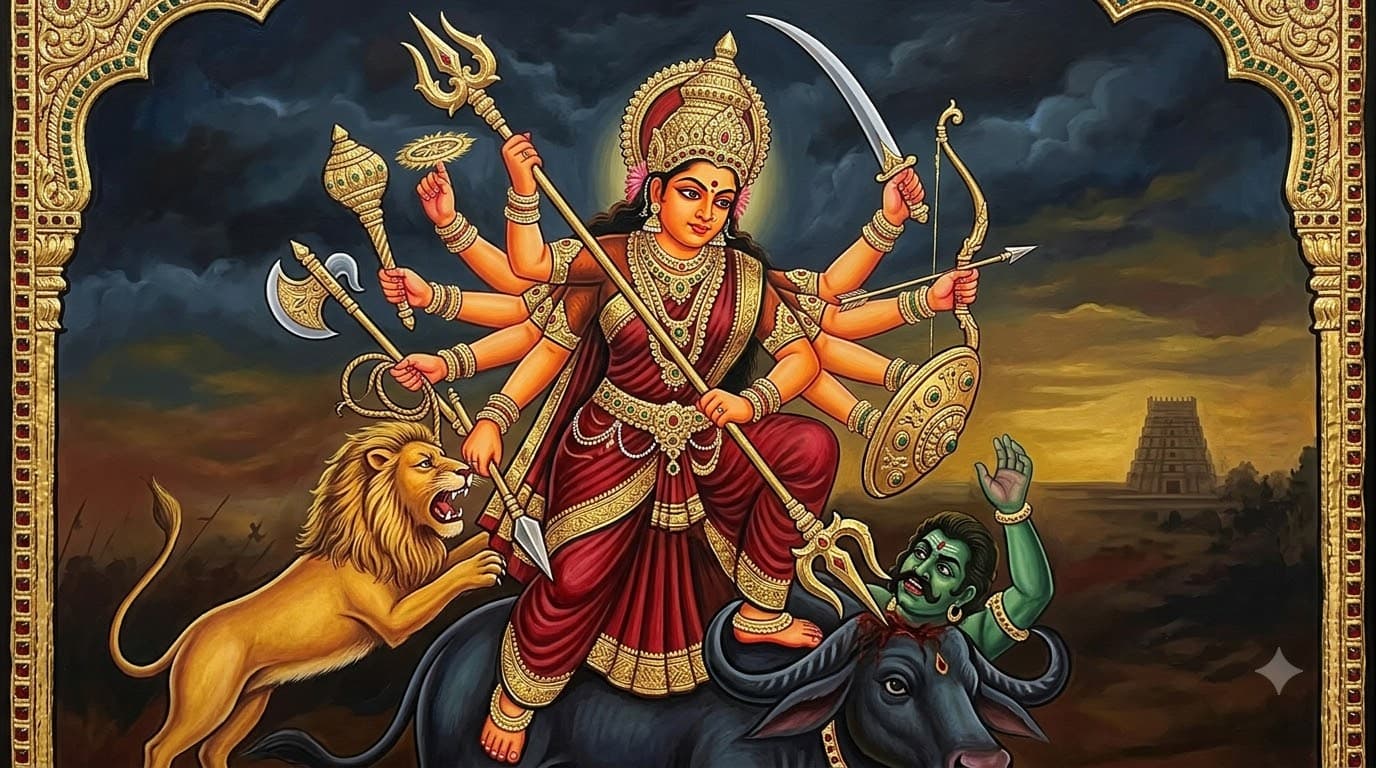
Mahishasuramardini's imagery is among the most instantly recognizable in the entire Devi tradition, built directly around the moment of her victory:
- Seat/stance: typically shown in active combat pose, often depicted at the moment of striking Mahishasura.
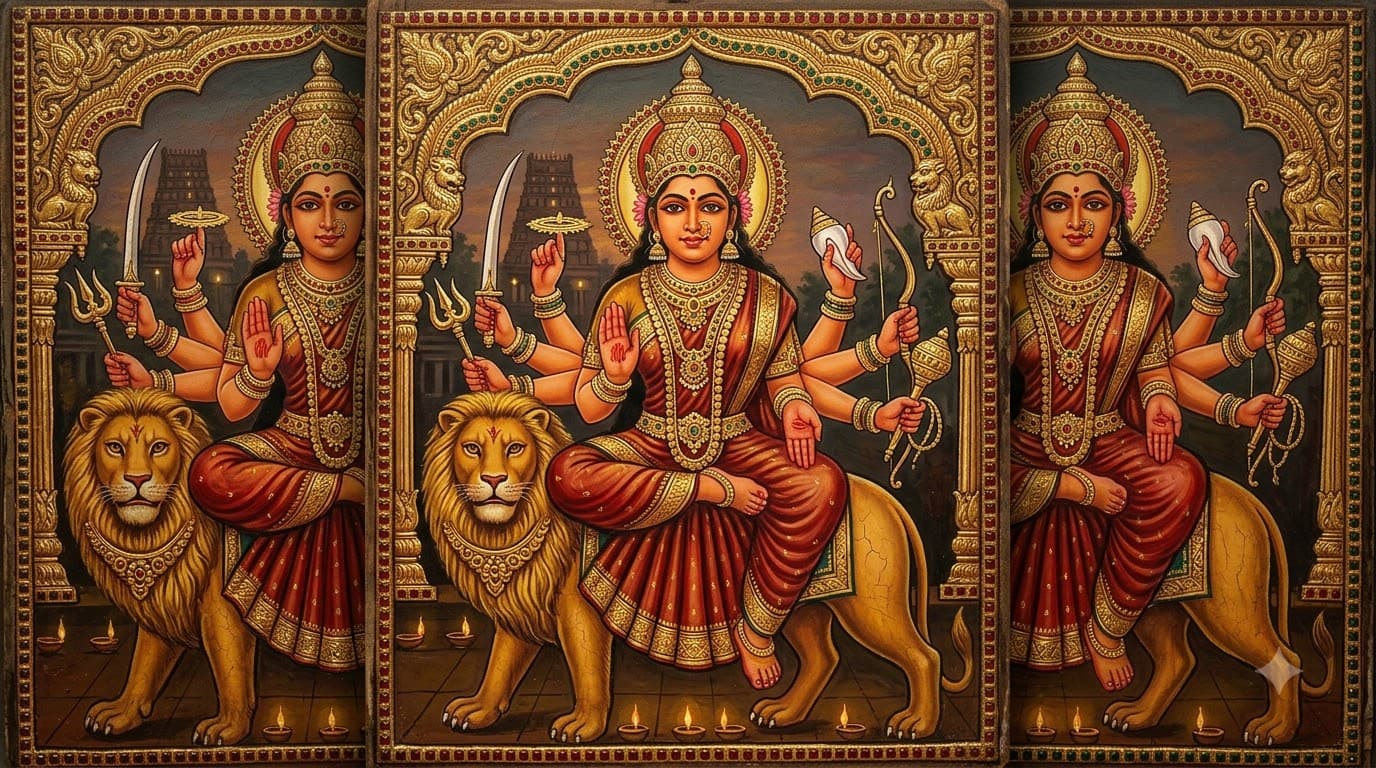
- Multiple arms, multiple weapons: commonly shown with eight or ten arms, each holding a weapon gifted by a different god — trident, discus, sword, bow, and more.
- Mount: a lion, the mount most closely associated with Durga's warrior identity.
- Mahishasura: usually depicted beneath her, in the process of being subdued — sometimes shown half-emerged from the buffalo's severed neck in human form, reflecting his shape-shifting in the legend.
- Expression: fierce but composed — focused resolve rather than uncontrolled anger.
Read together, the imagery isn't abstract the way some other Navratri days' symbolism is — it's a direct illustration of the Devi Mahatmyam's central battle, gathering the weapons and strength of every god into one decisive act.
4. When Is Mahishasuramardini Devi Worshipped in 2026?
Mahishasuramardini Devi is worshipped on Maha Navami, the ninth and final day of active Navratri puja, which falls on Monday, October 19, 2026 in Hyderabad and across Telangana, corresponding to Ashwin Shukla Navami.
These dates follow the Telugu (Amanta) panchangam observed in Telangana and Andhra Pradesh, verified against a Hyderabad-set calendar rather than a generic or North-India-default source. Maha Navami sits directly between Durga Ashtami (October 18) and Vijayadashami/Dasara (October 20, 2026) — read our Dussehra 2026 guide for the full date calendar across all three.
A caution worth keeping in mind: tithi timings are reckoned from local sunrise and can shift by a day between panchangams, or for readers outside India. If you're planning a specific puja or havan for Navami, it's worth confirming with a local panchangam or your pandit.
5. Spiritual Significance
Mahishasuramardini Devi's worship on Maha Navami is generally read as the resolution of the entire nine-day devotion — the point where the strength, discipline, and devotion built up across the earlier days culminates in the goddess's decisive act of protection. The legend is often taken as a reminder that evil, however powerful or shape-shifting it appears, does not go unanswered.
Because Maha Navami also functions as the practical close of the nine-day worship cycle, many households treat this day's puja as their most complete of the season — a final, fuller ritual before the idols and displays are packed away and the household turns toward Vijayadashami the next day.
6. How to Worship Mahishasuramardini Devi at Home
Maha Navami tends to carry the fullest puja of the nine days in most households, since it's the last day of active worship before Vijayadashami:
- Perform a fuller Kalasha puja: many households do a more elaborate abhishekam on this day than on the preceding eight.
- Offer red or lotus-toned flowers: along with the usual kumkum and akshata offerings.
- Conduct a havan, if your family's tradition includes one: Navami is the most common day for a Navratri havan (homam) to be performed, often marking the formal close of the nine days' worship.
- Recite the closing chants: her name and dedicated verses (see Section 7), often read alongside a summary recitation of the Devi Mahatmyam's central battle.
- Offer naivedyam: see Section 8 for what's traditionally offered.
Quick Tip: If your family performs Kanya Puja, this is one of the two days (alongside Ashtami) it's most commonly observed — check which convention your household follows before assuming it belongs to one day specifically.
7. Mantras & Chants
Mahishasuramardini Devi's widely published beej mantra is:
“Om Mahishasuramardinyai Namah”
This is typically chanted 108 times with a mala as part of her dedicated Navami puja. Many households and temples also recite the closing verses of the Durga Saptashati describing the battle with Mahishasura on this final day. If you're unsure of the exact Sanskrit for a fuller stotra, a sincere repetition of the beej mantra above, combined with her name, is considered sufficient for home worship.
8. Bhog & Naivedyam
A mix of nine varieties of food (navaratna bhog) or a sesame-based sweet is the offering most commonly cited for this day in Navratri tradition, alongside whatever dish the family has offered a young girl during Kanya Puja, if that custom is observed.
As with several of the Navratri days, there isn't one single, universally fixed dish reserved only for this occasion — it's more accurate to say households commonly treat this as the day for the fullest, most varied naivedyam spread of the whole nine days, rather than one specific fixed item.
9. Do's and Don'ts
Do:
- Treat Maha Navami as the fuller, closing puja of the season if your household's tradition builds toward it.
- Confirm your havan or Kanya Puja timing against a Telangana-set panchangam.
- Take time with the closing recitation — many families read a short summary of the Devi Mahatmyam's battle with Mahishasura on this day.
- Plan naivedyam as the most generous of the nine days if that's part of your family's practice.
Don't:
- Don't assume Navami and Ashtami are interchangeable for Kanya Puja timing — households vary on which day they use, so check your own family's convention.
- Don't skip confirming the exact tithi timing if you're planning a havan with a specific muhurat.
- Don't rush the closing rituals — Navami is generally treated as the day worth giving the most time to, not the least.
10. Interesting Facts About Mahishasuramardini Devi
- Mahishasuramardini is one of the oldest and most widely depicted forms of the Devi in Indian temple art, with sculptures and reliefs dating back well over a thousand years.
- Mahishasura is described as able to shape-shift between buffalo, lion, elephant, and human forms during the battle — his name and iconography still centers on the buffalo as his true shape.
- Her worship on Maha Navami often coincides with the season's most elaborate havan, closing the nine-day cycle with fire ritual rather than just idol worship.
- The multi-armed, multi-weaponed imagery associated with her battle is a direct visual reminder that the gods combined their individual strengths into hers rather than any one deity acting alone.
- Maha Navami sits just one day before Vijayadashami/Dasara — see our Dussehra 2026 guide for what comes immediately after this day closes.
13. References & Further Reading
- Navaratri — Wikipedia — overview of the nine-night festival and how Maha Navami closes it.
- Mahishasura — Wikipedia — background on the buffalo demon and the Devi Mahatmyam legend of his defeat.
- Navratri Day 9 (Navami) 2026 Date & Time, Hyderabad — DrikPanchang — the Hyderabad-specific panchangam source used for this year's Maha Navami date.
14. Final Thoughts
Nine nights, and Mahishasuramardini Devi closes the cycle not with a gentler quality but with the very act the whole festival ultimately points toward: a demon who thought himself untouchable, finally answered. Tomorrow the household turns toward Vijayadashami and whatever the year ahead asks of it — but tonight is still hers, the quiet, complete end of the climb.
Shubham.
Frequently Asked Questions
Q1. Who is Mahishasuramardini Devi and why is she worshipped on Day 9 of Navratri?
Mahishasuramardini Devi is worshipped on Maha Navami, the ninth and final day of Navratri, honoring Durga as the slayer of the buffalo demon Mahishasura. Her name combines Mahishasura and mardini (she who slays), directly naming this climactic act.
Q2. What is the date for Mahishasuramardini Devi puja / Maha Navami in 2026?
Maha Navami falls on Monday, October 19, 2026, in Hyderabad and Telangana, per the Telugu (Amanta) panchangam — the day after Durga Ashtami and the day before Vijayadashami/Dasara.
Q3. What is the legend behind Mahishasuramardini Devi?
Tradition holds that the buffalo demon Mahishasura had won near-invincibility from the gods and terrorized the heavens. Unable to defeat him individually, the gods combined their powers and weapons into Durga, who fought and slew him after he repeatedly shape-shifted to evade her.
Q4. Is Maha Navami the same as Vijayadashami/Dasara?
No. Maha Navami (October 19, 2026) is the ninth and final day of active Navratri worship, while Vijayadashami/Dasara (October 20, 2026) is the separate tenth-day festival that follows it, marking the close of the whole festival period.
Q5. What is Mahishasuramardini Devi's mantra?
Her widely published beej mantra is “Om Mahishasuramardinyai Namah,” typically chanted 108 times with a mala as part of her dedicated Maha Navami puja.
Q6. What is offered as naivedyam on Maha Navami?
A mix of nine food varieties (navaratna bhog) or a sesame-based sweet is most commonly cited, though households generally treat this as the day for the fullest, most varied naivedyam spread of the whole Navratri period rather than one fixed dish.
Q7. Why is Mahishasura shown shape-shifting in her iconography?
The legend describes Mahishasura changing between buffalo, lion, elephant, and human forms to try to escape Durga during their battle — his depiction half-emerged from the buffalo's form reflects that shape-shifting struggle before his defeat.
Q8. Should Kanya Puja be performed on Ashtami or Navami?
Both days are used, depending on family and regional tradition — some households observe it on Durga Ashtami, others on Maha Navami. It's worth checking which convention your own family follows rather than assuming one is universal.