Durga Devi: Navratri Day 8 2026 — Date & Puja Guide
By Divine center ·
Durga Devi, worshipped on Day 8 of Navratri 2026 (Durga Ashtami, Oct 18), is honored in her complete, victorious form. Here's her significance, iconography, and how her day overlaps with Saddula Bathukamma in Telangana.
1. Who Is Durga Devi?
Durga Devi is worshipped on Durga Ashtami, the eighth day of Navratri, in her general, complete form — the embodiment of shakti (divine feminine power) rather than one narrow aspect of it. Where several other days of Navratri honor the Devi through a specific facet — a stage of her story, a particular quality — Ashtami is simply her day: Durga worshipped as Durga, in her full, victorious identity.
At a Glance:
- Name meaning: Durga — “the one who is difficult to reach or overcome,” the warrior form of the goddess
- Navratri day: Day 8 of 9 (Durga Ashtami)
- 2026 date: Sunday, October 18, 2026 (Hyderabad/Telangana) — also Saddula Bathukamma in Telangana
- Mount (vahana): Lion
- Known for: shakti, protection, and victory — worshipped in her complete, general form as the festival builds toward Maha Navami
Did You Know? In Telangana, this same date is the finale of Bathukamma — Saddula Bathukamma — which means many households here are marking two significant observances on one day rather than treating Ashtami as a single, standalone festival.
2. The Significance of Durga Ashtami
Durga Ashtami doesn't carry a single fixed origin story the way some individual days of Navratri do — it's better understood as the point in the nine-night cycle where the goddess is worshipped in her complete, unqualified form, rather than through one specific stage of a longer narrative. Many temples and households treat this day as a kind of gathering point: the devotion built up across the earlier days of the festival is directed here at Durga herself, as the protector and warrior goddess, ahead of the climactic Mahishasura-slaying legend associated with Maha Navami the following day.
In several traditions, the twilight junction between the Ashtami and Navami tithis — known as Sandhi Puja — is treated as a particularly significant moment of worship, marking the transition into the festival's final, most intense day. As with the broader Navratri narrative, this is devotional tradition and regional custom rather than a single documented historical account, and practice varies between households and temples.
3. Iconography & Symbolism
Durga Devi's imagery on this day is built around completeness and readiness:
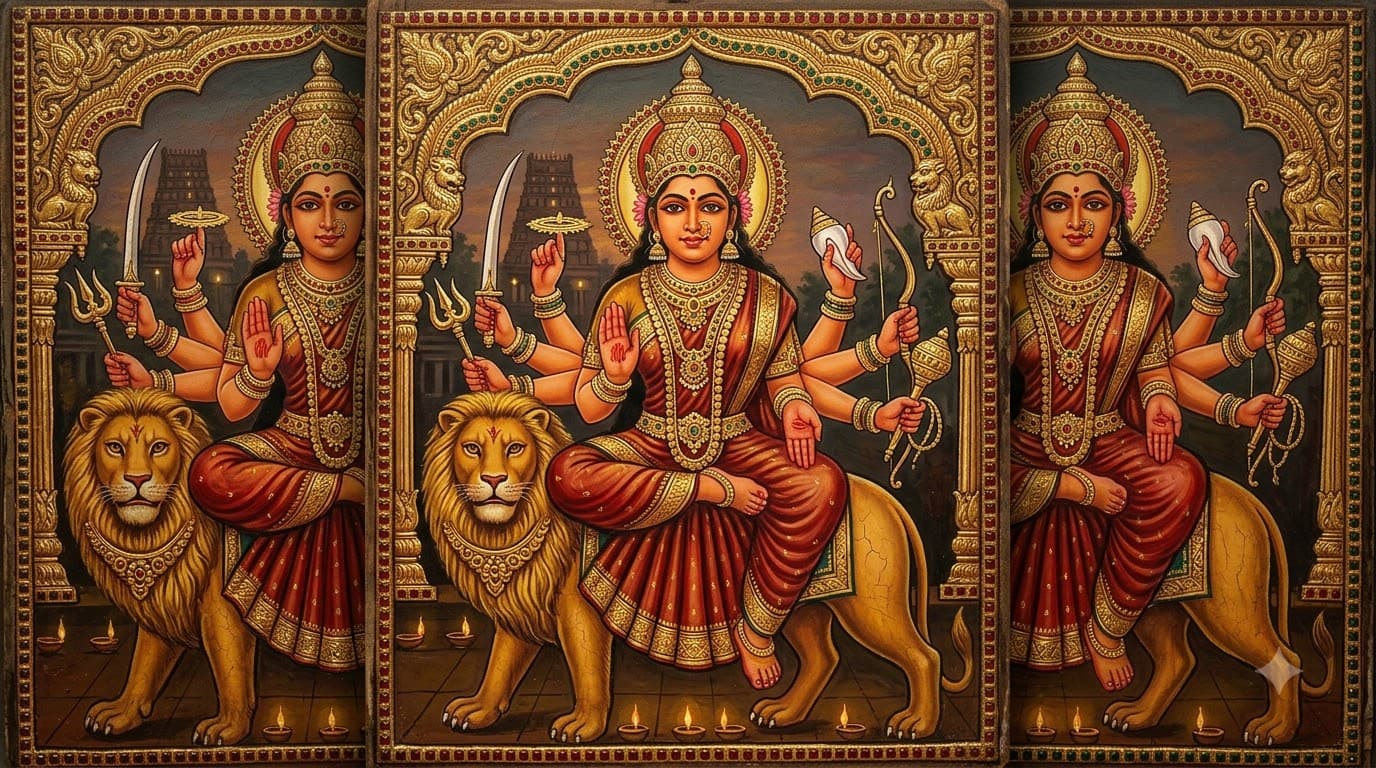
- Complexion & attire: commonly shown radiant and composed, often in red or gold, reflecting her role as the complete, victorious goddess.
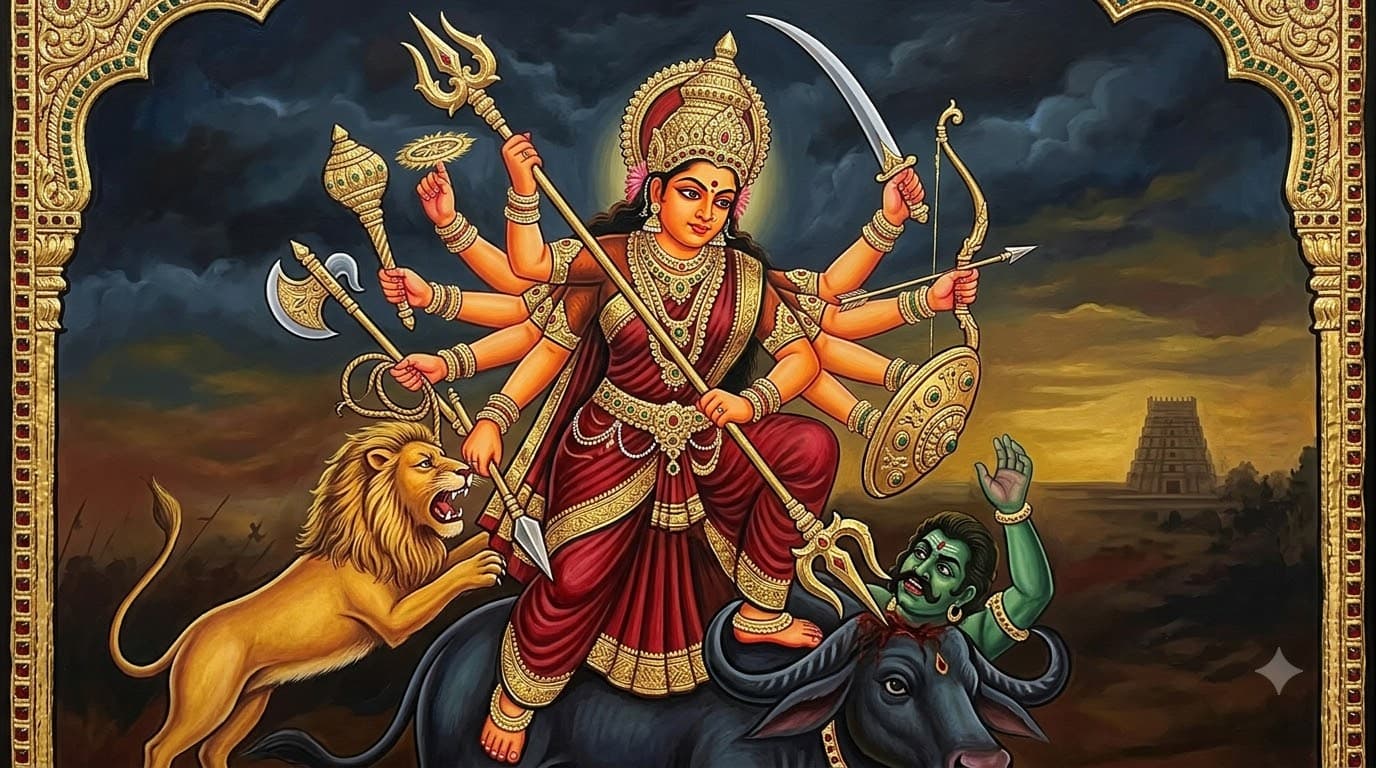
- Multiple arms: typically shown with eight or ten arms, each carrying a weapon gifted by a different god — a trident, discus, sword, bow, and more.
- Mount: a lion, her most consistently associated vahana, symbolizing courage and royal power.
- Expression: calm and composed even while armed for battle — strength held with control, not aggression for its own sake.
The combination of many weapons in many hands is generally read as a reminder that her power was assembled — each god contributing a weapon so that together they could face a threat none of them could handle alone. It's a visual statement about combined strength as much as it is about any one deity's individual power.
4. When Is Durga Devi Worshipped in 2026?
Durga Devi is worshipped on the eighth day of Navratri — Durga Ashtami — which falls on Sunday, October 18, 2026 in Hyderabad and across Telangana, corresponding to Ashwin Shukla Ashtami.
These dates follow the Telugu (Amanta) panchangam observed in Telangana and Andhra Pradesh, verified against a Hyderabad-set calendar rather than a generic or North-India-default source.
Panchangam Note: Durga Ashtami is one of the dates most likely to shift by a day depending on which panchangam you're checking. Many Telangana-focused sources place it on October 18, 2026 — the same day as Saddula Bathukamma — while some pan-India panchangams list Ashtami on October 19 instead. Neither is “wrong”; it reflects the same underlying tithi read against slightly different regional conventions (and, in some cases, the Amanta vs Purnimanta calendar difference).
A caution worth keeping in mind: tithi timings are reckoned from local sunrise and can shift by a day between panchangams, or for readers outside India. If you're planning a specific puja or Kanya Puja timing, it's worth confirming with a local panchangam or your pandit.
5. Spiritual Significance
Durga Devi's worship on Ashtami is generally read as devotion to shakti in its most complete, unqualified form — strength, protection, and victory called on directly rather than through one narrower aspect of the goddess. Devotion to this form is associated with courage and resolve heading into the festival's final stretch.
For many households, day eight also carries a practical significance: it's often treated as a natural midpoint for reflection before the intensity builds toward Navami and Vijayadashami — a pause built into the calendar rather than an accident of scheduling.
6. How to Worship Durga Devi at Home
A Durga Devi puja at home on Ashtami tends to be one of the fuller observances of the nine days:
- Dress the altar with care: red or gold cloth and flowers are commonly used for this day.
- Offer akshata and kumkum: turmeric-coated rice and kumkum, as with the other Navratri days.
- Light a diya: ghee is the traditional choice for this day's lamp in most households.
- Chant or recite: her name and dedicated verses, unhurried (see Section 7).
- Offer naivedyam: see Section 8 for what's traditionally offered.
Quick Tip: If your family observes Kanya Puja on this day, it's traditionally performed alongside — not instead of — the goddess puja: nine young girls are invited, their feet washed, and they are fed and given small gifts as living representations of the goddess. This is a widely observed North Indian custom on Durga Ashtami; in Telangana, many households mark this date primarily through Saddula Bathukamma instead — see our Bathukamma guide for that side of the day.
7. Mantras & Chants
Durga Devi's widely published beej mantra is:
“Om Dum Durgayai Namah”
This is typically chanted 108 times with a mala during her dedicated Navratri puja. As with the other Navratri days, her dhyana shloka is recited in temples and by those following a fuller Durga Saptashati practice; for home worship, a sincere repetition of the beej mantra above, along with her name, is considered sufficient — there's no need to reconstruct additional Sanskrit verses from memory.
8. Bhog & Naivedyam
Coconut is the naivedyam most commonly cited for Durga Devi's day across Navratri tradition, often offered alongside other sweets already part of a family's Navratri routine.
As with several days of the festival, there isn't one single, elaborate dish uniquely reserved for this day beyond the coconut offering — it's better to say that plainly than to invent a more specific food tradition. In Telangana households where Saddula Bathukamma coincides with this date, the day's food focus often shifts toward the Bathukamma-specific offerings (maleeda and other prasadam) rather than a separate dish for Durga Devi.
9. Do's and Don'ts
Do:
- Use red or gold-colored flowers and cloth if you're following that specific convention for the day.
- Confirm your Ashtami date against a Telangana-set panchangam, since this is one of the dates most prone to a one-day regional shift.
- If your household observes both Durga Devi puja and Saddula Bathukamma, plan the day so neither gets rushed.
- Offer coconut as naivedyam if that's part of your family's practice.
Don't:
- Don't assume Kanya Puja is universally observed — it's a widely practiced North Indian custom, but many Telangana households mark this date primarily through Bathukamma instead.
- Don't treat the October 18 vs 19 Ashtami question as an error on either source's part — it's a genuine, well-documented regional variation.
- Don't skip confirming the exact tithi timing if you're planning a strict muhurat for either observance.
10. Interesting Facts About Durga Devi
- Durga Ashtami is often treated as the day the goddess is worshipped in her most complete, unqualified form, ahead of the climactic Mahishasura-slaying story associated with Maha Navami.
- Her lion mount is one of the most consistently recognized symbols of the Devi across Indian iconography, appearing throughout Navratri and beyond.
- In Telangana, her day (Ashtami) coincides with Saddula Bathukamma, the grand finale of the state's own floral festival — one of the more striking festival overlaps on the Telugu calendar.
- Sandhi Puja, observed at the twilight junction of Ashtami and Navami in several traditions, is treated as one of the most auspicious short windows of the entire festival.
- Some temples specifically schedule their largest Durga Ashtami crowds around this day's rituals, treating the eighth day as one of the peak days of the entire Navratri period.
13. References & Further Reading
- Navaratri — Wikipedia — overview of the nine-night festival and how Durga Ashtami is observed within it.
- Durga Ashtami — Wikipedia — background on the Ashtami observance and regional customs like Kanya Puja.
- Navratri Day 8 (Ashtami) 2026 Date & Time, Hyderabad — DrikPanchang — the Hyderabad-specific panchangam source used for this year's Ashtami date.
14. Final Thoughts
Durga Devi's day is a reminder that the goddess honored across all nine nights of Navratri is, at her core, one complete and victorious presence — strength assembled from many sources and directed toward protection. Whether your household spends the eighth day in front of the goddess in her full form, seated with nine young girls for Kanya Puja, or out singing around a towering Saddula Bathukamma, the thread running through all of it is the same: devotion gathering itself before the festival's final day.
Shubhamastu.
Frequently Asked Questions
Q1. Who is Durga Devi and why is she worshipped on Day 8 of Navratri?
Durga Devi is worshipped on Durga Ashtami, the eighth day of Navratri, in her complete, victorious form — the embodiment of shakti (divine feminine power) as protector and warrior goddess, honored ahead of the festival's climactic final day.
Q2. What is the date for Durga Devi puja / Durga Ashtami in 2026?
Durga Ashtami falls on Sunday, October 18, 2026, in Hyderabad and Telangana, per the Telugu (Amanta) panchangam. Some pan-India panchangams list Ashtami on October 19 instead — check a Telangana-set source to confirm your household's date.
Q3. Is Durga Devi's day the same as Saddula Bathukamma?
They fall on the same calendar date in 2026 (October 18) but are separate observances. Durga Devi is worshipped pan-India during Navratri, while Saddula Bathukamma is Telangana's own floral festival finale — see our dedicated Bathukamma guide for that tradition.
Q4. What is Kanya Puja and is it performed everywhere on this day?
Kanya Puja involves inviting nine young girls, washing their feet, and feeding and gifting them as living representations of the goddess. It's a widely observed North Indian custom on Durga Ashtami; in Telangana, many households mark this date primarily through Saddula Bathukamma instead.
Q5. What is Sandhi Puja?
Sandhi Puja is worship offered at the twilight junction between the Ashtami and Navami tithis, treated in several traditions as one of the most auspicious short windows of the entire festival, marking the transition into Navratri's final day.
Q6. What is Durga Devi's mantra?
Her widely published beej mantra is “Om Dum Durgayai Namah,” typically chanted 108 times with a mala during her dedicated Navratri puja.
Q7. What is offered as naivedyam to Durga Devi?
Coconut is the offering most commonly cited for her day. There isn't one single elaborate dish uniquely reserved for this day beyond that, and in Telangana households the food focus often shifts toward Bathukamma prasadam on the same date.
Q8. Why do sources disagree on whether Durga Ashtami is October 18 or 19, 2026?
Tithi timings are calculated from local sunrise, so the same tithi can be attributed to different calendar dates depending on the panchangam and region used. It's worth confirming with a local, Telangana-set panchangam or your pandit if you're planning a specific muhurat.