Raja Rajeshwari Devi: Navratri Day 10 2026 — Date & Puja Guide
By Divine center ·
Raja Rajeshwari Devi closes Navratri on Vijayadashami, October 20, 2026 — the sovereign form under whose authority the nine days of worship are understood to conclude.
1. Who Is Raja Rajeshwari Devi?
Raja Rajeshwari Devi means, roughly, “empress of kings” or “sovereign ruler” — from Raja (king/ruler) and Rajeshwari (empress/one who rules). She is worshipped on Vijayadashami, the tenth and final day of Navratri, as the culminating, all-ruling form of the Divine Mother — the one under whose authority the nine days of worship are understood to conclude.
In the Sri Vidya tradition, Raja Rajeshwari is closely associated with Lalita Tripura Sundari (honored earlier in this same Navratri, on Day 5) — the two names are often used for the same supreme, cosmos-ruling aspect of the goddess, with Raja Rajeshwari emphasizing her role as sovereign empress in particular. Where the earlier days of Navratri build through different forms and moods, this final day's worship is generally understood as the goddess taking her seat, fully victorious, over everything the nine days built toward.
At a Glance:
- Name meaning: Empress of Kings / Sovereign Ruler
- Navratri day: Day 10 (Vijayadashami)
- 2026 date: Tuesday, October 20, 2026
- Associated with: Lalita Tripura Sundari (Day 5) in the Sri Vidya tradition, worshipped here in her sovereign, victorious aspect
- Known for: Ruling authority over the completed nine days of worship; the culminating form of Navratri
Did You Know? Vijayadashami itself is a much larger festival than Raja Rajeshwari Devi's worship alone — it's also the day of Ayudha Puja, Jammi Puja, and (in the northern tradition) Ravana Dahan. For the full picture of the day, see our Dussehra 2026 guide; this post focuses specifically on the goddess honored that day.
3. Iconography & Symbolism
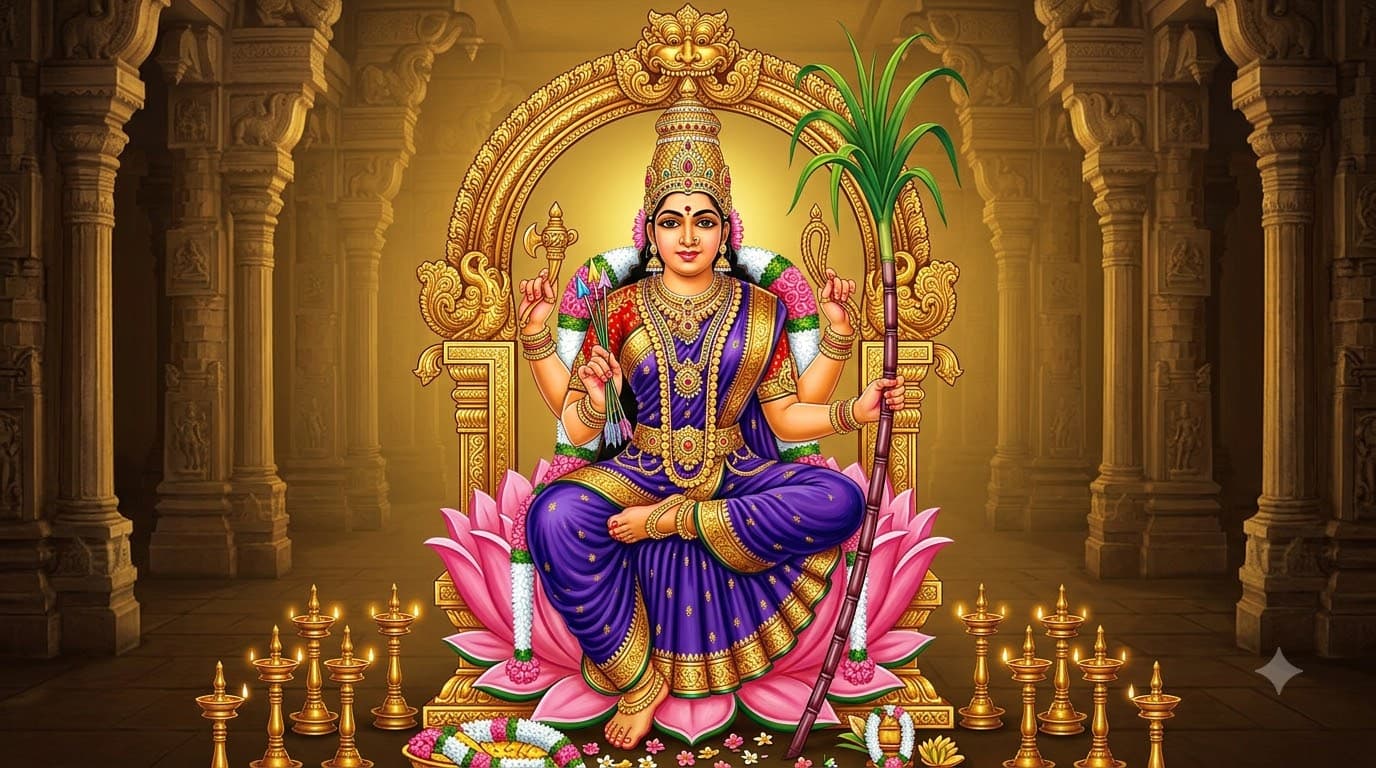
Raja Rajeshwari is generally depicted enthroned rather than in motion — seated in royal posture, often on a lotus or a throne, wearing a crown befitting her title as empress, with a calm, commanding expression rather than the battle-readiness shown in some of Navratri's earlier forms. She is typically shown four-armed, holding a noose (pasha) and a goad (ankusha) — the same symbolic pair carried by Lalita Tripura Sundari — along with a bow and arrow fashioned from sugarcane and flowers.
What these elements are said to represent: the noose for drawing devotees toward the divine, the goad for guiding and correcting, and the sugarcane bow and flower arrows for the idea that even her authority operates through beauty and attraction rather than force alone. Her throne itself is the most direct symbol in this iconography — after nine days of forms in motion, she is shown settled, ruling.
4. When Is Raja Rajeshwari Devi Worshipped in 2026?
Raja Rajeshwari Devi is honored on Tuesday, October 20, 2026, which is Vijayadashami — Ashwin Shukla Dashami, the tenth tithi and the final day of Navratri worship.
These dates follow the Telugu (Amanta) panchangam observed in Telangana and Andhra Pradesh.
Panchangam Note: Tithi-based observances are reckoned from local sunrise and can shift by a day between panchangams, or for readers outside India. It's worth confirming the exact timing with a local panchangam or your pandit, particularly if you're planning Ayudha Puja or another specific ritual around a muhurat.
5. Spiritual Significance
Worship on this closing day is generally understood as an act of gratitude and completion rather than petition — the nine days of effort, whatever form they took in a given household, are being formally closed under the goddess's authority. Where earlier days of Navratri often ask for strength, protection, or knowledge, devotion to Raja Rajeshwari on Vijayadashami is more commonly framed around surrender and acknowledgment: recognizing that whatever was sought across the nine days is now, in tradition's telling, under her rule.
This is also why Vijayadashami is treated as such an auspicious day for new beginnings — tools blessed, children beginning their studies, ventures started. The idea is that anything begun under a sovereign, victorious goddess's authority carries her protection forward.
6. How to Worship Raja Rajeshwari Devi at Home
Most households don't set up a separate, distinct puja for Raja Rajeshwari apart from their general Vijayadashami observance — her worship is woven into the day's broader rituals rather than treated as a standalone ceremony:
- Close the Kalasham: the Kalasham installed on Ghatasthapana (Day 1) is typically closed and the water offered to plants or poured respectfully, marking the formal end of the nine-day worship.
- Offer a final archana: a short, sincere archana or simple puja acknowledging the goddess in her completed, sovereign form.
- Ayudha Puja: tools, vehicles, and instruments blessed as part of the day (see our Dussehra guide for the full ritual).
- Jammi Puja: exchange Jammi/Shami leaves with family and neighbors as a gesture of goodwill under her authority.
Quick Tip: If you're closing out a nine-day Navratri vratam or fast, this is the day it formally ends — check with your pandit on the correct closing procedure (udyapana) if your family's observance calls for one.
7. Mantras & Chants
Raja Rajeshwari is closely tied to the Sri Vidya tradition, where her worship — like Lalita Tripura Sundari's — traditionally involves mantras transmitted through formal guru initiation (diksha) rather than published freely for home use. For a general home puja on Vijayadashami, most families instead recite the general Devi mantra: “Om Hreem Devyai Namaha”, or a simple expression of gratitude in their own words, rather than a specific Raja Rajeshwari mantra.
If you have received formal Sri Vidya initiation and know the specific mantras for this form, those take precedence over anything general — this section is written for households without that initiation.
8. Naivedyam on Vijayadashami
There isn't a single fixed naivedyam tied specifically to Raja Rajeshwari the way some earlier Navratri days have a distinct dish — Vijayadashami's food traditions are generally part of the broader festival rather than form-specific. Many households prepare something festive and shareable: payasam, laddus, or whatever sweets are customary for closing a festival in that family. What matters more than the specific dish is that it's offered with the same completion-and-gratitude spirit as the rest of the day's rituals.
9. Do's and Don'ts for Vijayadashami
Do:
- Close your Kalasham and any nine-day vratam properly, checking the correct udyapana procedure with a pandit if unsure.
- Treat the day as one of completion and gratitude rather than petition.
- Combine Raja Rajeshwari's worship with the day's broader Ayudha Puja and Jammi Puja rituals rather than trying to isolate a separate ceremony.
Don't:
- Don't attempt Sri Vidya-specific mantras without proper initiation — use the general Devi mantras instead.
- Don't rush the closing rituals just because the nine days are technically over — many families treat Vijayadashami's own puja with as much care as Ghatasthapana.
10. Interesting Facts
- In the Sri Vidya tradition, Raja Rajeshwari and Lalita Tripura Sundari are widely regarded as the same supreme goddess described in two different roles — the earlier honoring her beauty and pervasiveness, the closing day honoring her sovereignty.
- At Tirumala, the Sri Venkateswara Swamy Brahmotsavam concludes on this same day, with Chakrasnanam (the ceremonial bathing of the deity's Sudarshana Chakra) and Dwajavarohanam (the lowering of the festival flag) marking the close of both observances together.
- Vijayadashami's association with new beginnings — Vidyarambham, Ayudha Puja, business launches — stems directly from this idea of starting things under an already-victorious, sovereign goddess's protection.
13. References & Further Reading
- Lalita Tripurasundari — Wikipedia — background on the Sri Vidya tradition's supreme goddess form, closely linked to Raja Rajeshwari.
- Vijayadashami — Wikipedia — for the broader festival context this day's worship sits within.
- Vijayadashami 2026 Date & Time, Hyderabad — DrikPanchang — the Hyderabad-specific panchangam source used for this year's date.
14. Final Thoughts
Ten days after the first Kalasham went up, the house is quieter, but not emptier — the flowers are gone, the lamps are out, but whatever was asked for across those nine days is, in tradition's telling, now sitting under a sovereign's protection. Raja Rajeshwari's day isn't about asking anymore. It's about closing well, thanking properly, and letting the new year's first steps begin under her rule.
Shubhamastu.
Frequently Asked Questions
Q1. What does the name Raja Rajeshwari Devi mean?
Raja Rajeshwari means “empress of kings” or “sovereign ruler,” reflecting her role as the supreme, all-ruling form of the Divine Mother worshipped on the closing day of Navratri.
Q2. When is Raja Rajeshwari Devi worshipped in 2026?
She is honored on Vijayadashami, Tuesday, October 20, 2026 — the tenth and final day of Navratri, following the Telugu (Amanta) panchangam observed in Telangana.
Q3. Is Raja Rajeshwari Devi the same as Lalita Tripura Sundari?
In the Sri Vidya tradition, the two names are widely understood to describe the same supreme goddess — Lalita Tripura Sundari emphasizing her beauty and pervasiveness (worshipped on Day 5), and Raja Rajeshwari emphasizing her sovereignty (worshipped on Day 10).
Q4. Do I need a separate puja for Raja Rajeshwari, or is it part of Vijayadashami's general rituals?
Most households don't hold a distinct, standalone ceremony for her — her worship is woven into the day's broader Vijayadashami observance, including closing the Kalasham and performing Ayudha Puja.
Q5. Is there a specific mantra for Raja Rajeshwari Devi?
Her worship is closely tied to Sri Vidya tradition, where specific mantras are traditionally given through formal guru initiation rather than published for general use. Households without that initiation typically use a general Devi mantra instead.
Q6. What should be offered as naivedyam on this day?
There isn't one fixed dish tied specifically to Raja Rajeshwari — most families prepare festive sweets like payasam or laddus as part of the broader Vijayadashami celebration.
Q7. How does Raja Rajeshwari's day connect to Tirumala's Brahmotsavam?
The Sri Venkateswara Swamy Brahmotsavam at Tirumala concludes on the same day, with Chakrasnanam and Dwajavarohanam marking the close of that festival alongside Vijayadashami.
Q8. How is this different from the general Dussehra/Vijayadashami festival?
Vijayadashami is the full festival day — covering Durga's or Rama's victory, Ayudha Puja, and Jammi Puja among other things. This post focuses specifically on Raja Rajeshwari Devi, the goddess form honored that day; see our Dussehra 2026 guide for the complete festival picture.