Lalita Tripura Sundari Devi: Navratri Day 5 2026 — Date & Puja Guide
By Divine center ·
Lalita Tripura Sundari Devi, worshipped on Navratri Day 5, October 15, 2026 — her legend, iconography, mantra, and how to observe her day at home in Telangana.
1. Who Is Lalita Tripura Sundari Devi?
Lalita Tripura Sundari Devi is the deity honored on the fifth day of Navratri. Her name is built from two parts: "Lalita" (the playful one, she who plays) and "Tripura Sundari" (the beauty of the three worlds). She is a major goddess in the Sri Vidya tradition of Shaktism, regarded there as a supreme, all-pervading form of Devi, worshipped through the geometric yantra known as the Sri Chakra. This day is also observed separately in parts of India as Lalita Panchami.
At a Glance:
- Name: Lalita Tripura Sundari Devi ("the playful beauty of the three worlds")
- Navratri Day: Day 5
- 2026 Date: Thursday, October 15, 2026
- Also Observed As: Lalita Panchami in parts of India
- Known For: Presiding deity of the Sri Chakra in the Sri Vidya tradition, regarded as a supreme, all-pervading form of Devi
2. The Legend of Lalita Tripura Sundari Devi
The Lalitopakhyana tradition, found in texts such as the Brahmanda Purana, holds that Devi manifested in this form to end the tyranny of the demon Bhandasura, born from a sacred fire lit by the gods when no existing power could restore balance. She is described as emerging fully formed and radiant, and is regarded thereafter as presiding over the Sri Chakra, the yantra central to her worship in the Sri Vidya tradition.
The elders who pass this story down usually frame it less as a single battle narrative and more as an account of Devi's own supreme, self-existent nature taking on a specific, worshipped form — one defined by poise and radiance rather than combat.
3. Iconography & Symbolism
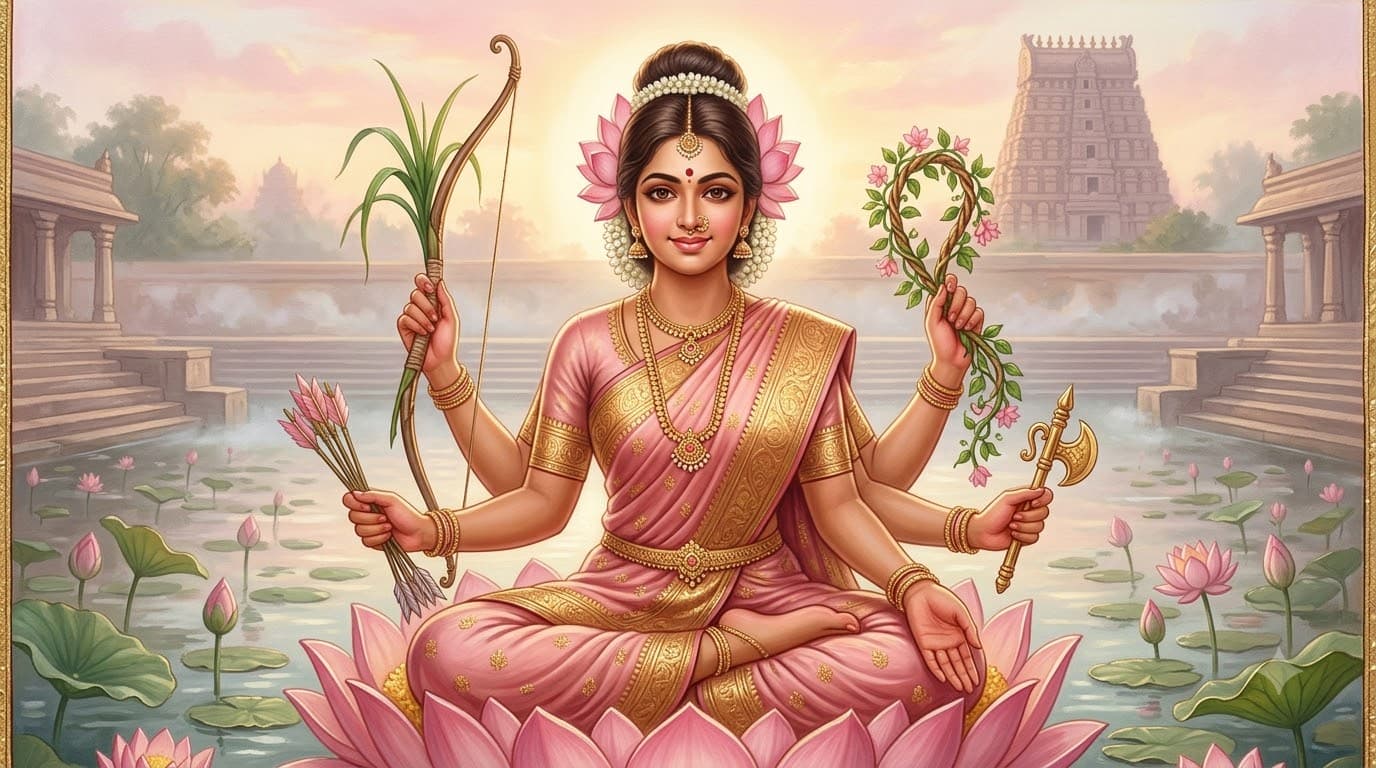
Lalita Tripura Sundari Devi is generally depicted four-armed, seated on a lotus or throne, with a reddish, dawn-like complexion:
- Sugarcane bow: representing the mind, from which the arrows of attention are released
- Five flower arrows: symbolizing the five senses
- Noose (pasha): representing attachment
- Goad (ankusha): representing control over impulses
In some depictions, she is shown seated on a throne supported by the five forms of Shiva, a detail meant to signify her supremacy even over consciousness itself — a devotional image rather than a literal claim.
4. When Is Lalita Tripura Sundari Devi Worshipped in 2026?
In 2026, Lalita Tripura Sundari Devi is worshipped on Thursday, October 15, the fifth day of Navratri, corresponding to Ashwin Shukla Panchami — a date also observed independently in parts of India as Lalita Panchami. These dates follow the Telugu (Amanta) panchangam observed in Telangana and Andhra Pradesh, cross-checked against a Hyderabad-set panchangam rather than a generic or North-India-default one.
Panchangam Note: as with every tithi-based observance, Panchami timings are reckoned from local sunrise and can shift by a day between panchangams, or for readers outside India. If a specific muhurat matters for your family's puja, confirm the exact window with a local panchangam or pandit rather than a single online source.
5. Spiritual Significance
Worship of Lalita Tripura Sundari Devi on this day is associated with beauty and grace understood as spiritual qualities in their own right — poise, mastery over the senses, and an unshaken sense of one's own power. Her iconography, particularly the sugarcane bow and flower arrows, is read as a teaching about discipline over the senses rather than indulgence of them.
It's worth being clear that her fullest tradition, Sri Vidya, is an advanced, initiation-based practice passed from guru to disciple. What most households observe during Navratri is a simpler, devotional layer of her worship — which tradition holds is entirely sufficient on its own.
6. How to Worship Lalita Tripura Sundari Devi at Home
A home puja for her day fits into the ongoing Navratri routine, with a few specific touches:
- Clean the puja space and refresh the kalasham water and flowers, as on the previous four days.
- Offer red hibiscus or any fresh red flower available, along with kumkum and turmeric.
- Recite her dhyana shloka, or the Lalita Sahasranama if your family has the time and tradition for it.
- If your family is not initiated into the Sri Vidya tradition, a simple, sincere devotional recitation is entirely sufficient — no elaborate ritual is required.
- Offer the day's naivedyam (see Section 8) and share it with family.
7. Mantras & Chants
A widely used devotional mantra for Lalita Tripura Sundari Devi is:
"Om Lalitayai Namah"
This is generally chanted 108 times with a japa mala. Many households also recite the Lalita Sahasranama, a stotra of her thousand names, as part of the day's puja. Her most esteemed Sri Vidya mantras — the Panchadashi and Shodashi — are traditionally received only through initiation (diksha) from a qualified guru and are not meant for general, unguided use; the devotional mantra and stotra above are what most households use for home worship.
8. Bhog & Naivedyam
A commonly cited tradition associates this day with offering coconut and red-colored sweets as naivedyam, along with a simple kheer or payasam. As with the other days in this series, there isn't a single dish every Telugu household treats as fixed for this day — these are common conventions, not a strict rule.
9. Do's and Don'ts
Do:
- Offer red flowers if available, given their place in the day's tradition.
- Recite the Lalita Sahasranama if your family is familiar with it.
- Approach the day with a sense of grace and composure rather than urgency.
Don't:
- Don't take up the esoteric Sri Vidya mantras casually without proper initiation from a qualified guru.
- Don't skip verifying the Panchami tithi timing against a Hyderabad-set panchangam if a specific muhurat matters to your family.
- Don't confuse Lalita Panchami with unrelated festivals of a similar name observed in other regions.
10. Interesting Facts
- Lalita Tripura Sundari Devi is regarded in the Sri Vidya tradition as a supreme, all-pervading form of Devi, worshipped through the Sri Chakra yantra.
- Kanchipuram's Kamakshi Amman temple and other major Shakta temples are closely associated with her worship.
- Her title "Tripura Sundari" is sometimes read as beauty presiding over the three states of consciousness — waking, dreaming, and deep sleep — alongside the more literal reading of the three worlds.
- The Lalita Sahasranama, one of the most widely recited stotras in the Shakta tradition, is dedicated entirely to her thousand names.
- The day is separately observed in parts of India as Lalita Panchami, and in some households marks the start of preparations for the Saraswati puja days later in Navratri.
13. References & Further Reading
- Tripura Sundari — Wikipedia — background on her name, iconography, and place in the Sri Vidya tradition.
- Navratri 2026 Date & Day 5, Hyderabad — DrikPanchang — the Hyderabad-specific panchangam source used for the 2026 date and tithi.
- Sri Vidya — Wikipedia — the wider Shakta tradition centered on the Sri Chakra and the worship of Devi in this supreme form.
14. Final Thoughts
Lalita Tripura Sundari Devi's day doesn't ask for anything dramatic — no elaborate ritual, no fierce imagery to work yourself up for. It just asks you to notice a quieter kind of strength: the poise that doesn't need to prove itself, the beauty that is simply at ease with its own power. That's really the whole point of this form — grace that is still, unmistakably, strength.
Shubhamastu.
Frequently Asked Questions
Q1. What does the name Lalita Tripura Sundari mean?
Lalita means "the playful one," and Tripura Sundari means "the beauty of the three worlds." Together, the name describes a supreme, radiant form of Devi central to the Sri Vidya tradition of Shaktism.
Q2. When is Lalita Tripura Sundari Devi worshipped in 2026?
She is worshipped on Thursday, October 15, 2026, the fifth day of Navratri, corresponding to Ashwin Shukla Panchami in the Telugu (Amanta) panchangam followed in Telangana and Andhra Pradesh.
Q3. Is Lalita Panchami the same day as Navratri Day 5?
Yes, in the Telugu (Amanta) panchangam followed in Telangana and Andhra Pradesh, Ashwin Shukla Panchami falls on the fifth day of Navratri and is the same day separately referred to as Lalita Panchami in parts of India.
Q4. What is the legend behind Lalita Tripura Sundari Devi?
The Lalitopakhyana tradition holds that Devi manifested in this form, born from a sacred fire lit by the gods, to end the tyranny of the demon Bhandasura. She is thereafter regarded as presiding over the Sri Chakra, the yantra central to her worship.
Q5. What does Lalita Tripura Sundari Devi hold in her hands?
She is typically shown holding a sugarcane bow, five flower arrows, a noose (pasha), and a goad (ankusha) — symbols read as representing the mind, the five senses, attachment, and control over impulses.
Q6. What is Lalita Tripura Sundari Devi's mantra, and can anyone chant it?
The devotional mantra "Om Lalitayai Namah" and the Lalita Sahasranama stotra are open to general devotional use. Her esoteric Sri Vidya mantras, the Panchadashi and Shodashi, are traditionally received only through initiation from a qualified guru.
Q7. Is Lalita Tripura Sundari Devi the same as Durga?
Not exactly. Within Shakta tradition, both are understood as forms of the one supreme Devi, but Lalita Tripura Sundari is specifically the Sri Vidya tradition's form, associated with beauty, grace, and the Sri Chakra, distinct from Durga's more commonly known warrior identity.
Q8. Can Navratri dates differ between panchangam sources?
Yes. Tithi-based dates are calculated from local sunrise and can shift by a day between panchangams or for readers outside India. It's worth confirming the exact date with a Telangana-set panchangam or your pandit if a specific muhurat matters.