Gayatri Devi: Navratri Day 3 2026 — Date & Puja Guide
By Divine center ·
Gayatri Devi, worshipped on Day 3 of Navratri, combines bridal grace with battle-readiness. Here's her legend, iconography, 2026 date, and puja steps.
1. Who Is Gayatri Devi?
Gayatri Devi is the goddess who personifies the Gayatri Mantra — the most revered mantra in the Vedic tradition, and one regarded as the mother of the Vedas themselves. She is worshipped on the third day of Navratri, in the same sequence of forms tradition attaches to Parvati's story.
Tradition holds that this day is also linked to the form Parvati took just after her marriage to Shiva, adorning herself with the crescent moon he wears — a detail woven into the day's Puranic narrative alongside the Vedic identity the alankaram itself represents.
At a Glance:
- Name meaning: The goddess who personifies the Gayatri Mantra, mother of the Vedas
- Navratri day: Day 3
- 2026 date: Tuesday, October 13, 2026
- Mount/vahana: A tiger (in some accounts described as a lion)
- Known for: Ten arms, multiple weapons, and a battle-ready form combined with serene, golden-hued beauty
2. The Legend of Gayatri Devi
According to tradition, once Parvati's tapasya as the young, penance-keeping goddess of the previous day succeeded in winning Shiva's hand, she took on this new form as a newly married goddess — adorning her forehead with Shiva's own crescent-moon ornament, shaped like a small bell, which is where her name comes from.
The Devi Mahatmyam tradition also folds a fiercer role into this same form: Gayatri Devi, in this aspect, is described as taking up arms and readiness for battle against forces of evil whenever needed, her serenity as a bride sitting alongside an entirely separate capacity for war. It's this combination — a wedding-day goddess who is simultaneously armed for conflict — that later Puranic retellings return to again and again when describing her.
3. Iconography & Symbolism
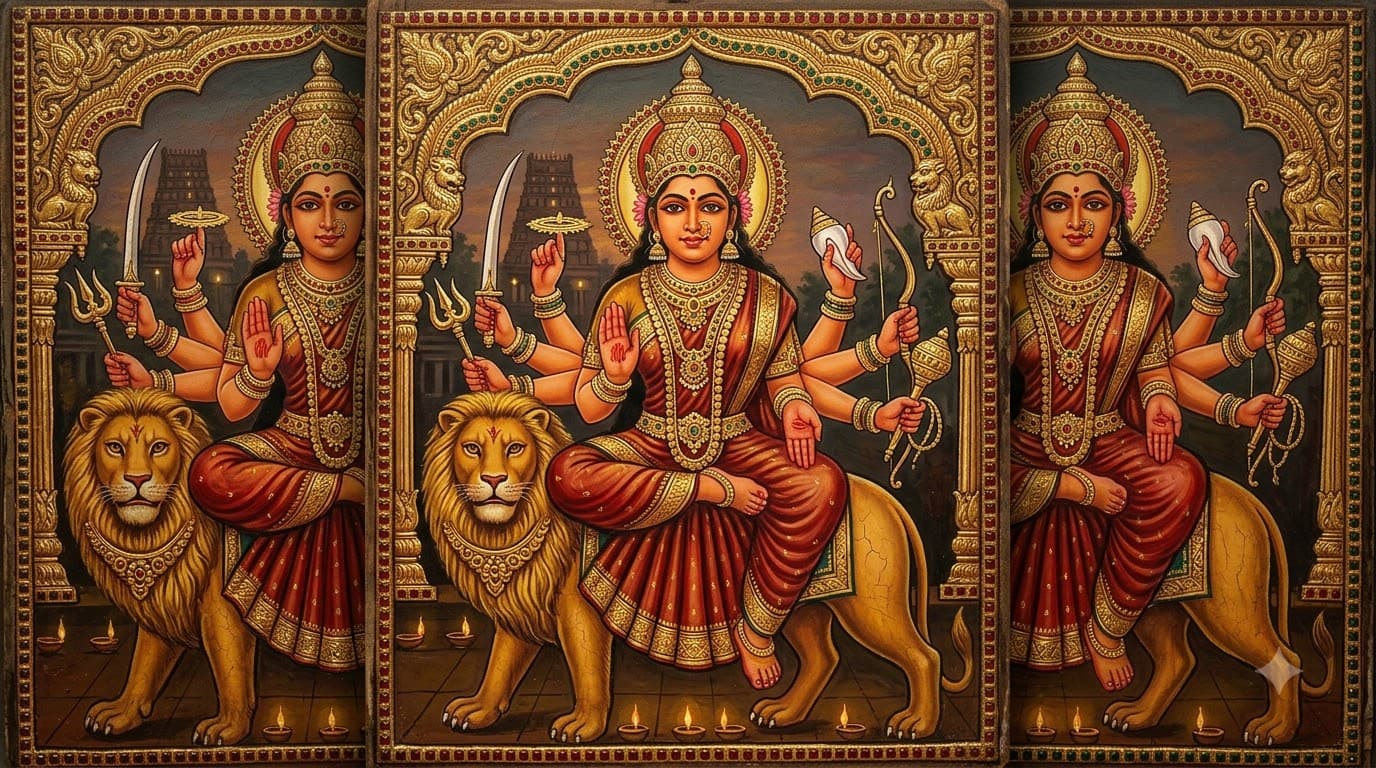
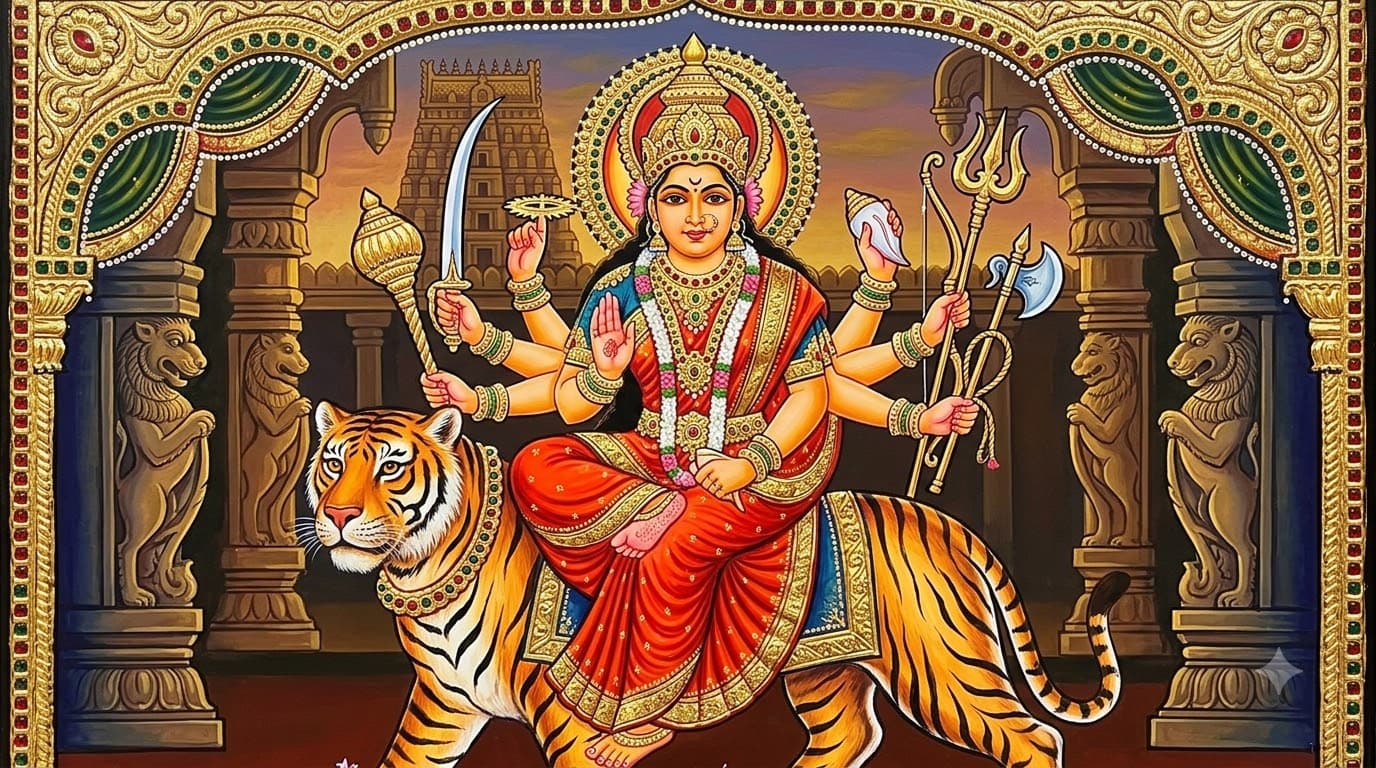
Gayatri Devi, in her battle-ready aspect linked to this day, is usually depicted with ten arms and a golden or bright complexion, riding a tiger (sometimes described in regional retellings as a lion), carrying an array of weapons that mark her out as ready for battle even in this early, newlywed form.
- The crescent-moon bell: worn on her forehead, said to represent both her marriage to Shiva and a sound that drives away negative energy
- Ten arms and multiple weapons: commonly described as including a trishul, gada (mace), sword, and bow, signaling readiness for conflict
- Tiger/lion mount: associated with courage and the fearlessness needed to face danger without hesitation
- Golden complexion: read in tradition as radiance and grace, held alongside the martial imagery rather than replacing it
Tradition reads her form as bravery and grace held together rather than in tension — a reminder, many say, that gentleness and the capacity to fight are not opposites.
4. When Is Gayatri Devi Worshipped in 2026?
Gayatri Devi is worshipped on Tuesday, October 13, 2026, which falls on Tritiya, the third tithi of Navratri.
These dates follow the Telugu (Amanta) panchangam observed in Telangana and Andhra Pradesh.
Panchangam Note: Tithi-based observances are reckoned from local sunrise and can shift by a day between panchangams, or for readers outside India. It's worth confirming Tritiya's exact timing with a local panchangam or your pandit before fixing your puja hour.
5. Spiritual Significance
Devotion to Gayatri Devi is traditionally believed to grant courage and protection from fear, along with a kind of poise under pressure — the ability to remain composed while still being prepared to act decisively if needed. Some traditions also connect the sound of her bell-shaped moon ornament to clearing negative energy from a space, though this is best understood as a symbolic and devotional belief rather than a claim with any independent scientific basis.
Her day is often described as the point in Navratri where the goddess's warrior character starts coming forward more clearly, ahead of later days in Navratri where that battle-readiness becomes even more central.
6. How to Worship Gayatri Devi at Home
- Continue Kalasham worship: offer the day's prayers to the installed Kalasham, inviting Gayatri Devi's presence for the day
- Bell or ghanta: many households ring a small bell during the puja on this day specifically, as a nod to her name and form
- Offerings: kumkum, akshatalu, and a red or grey flower where possible, since these are among the colors popularly associated with her day
- Harati: close with harati and share prasadam with the household
Some families also use this day to say a short prayer for courage or protection for a family member facing a difficult situation, in keeping with the qualities tradition attaches to her form.
7. Mantras & Chants
Since this alankaram personifies the Gayatri Mantra itself, the mantra most closely associated with this day's worship is the Gayatri Mantra:
"Om Bhur Bhuvah Swaha, Tat Savitur Varenyam, Bhargo Devasya Dheemahi, Dhiyo Yo Nah Prachodayat"
Households also commonly recite Navadurga Stotra verses appropriate to the third day of Navratri during her puja. If you're not confident of the exact Sanskrit pronunciation, it's better to have a pandit lead the chanting than to guess at an unfamiliar verse.
8. Bhog & Naivedyam
A commonly cited tradition associates Gayatri Devi's day with an offering of milk or milk-based sweets, linked to the idea of purity and physical well-being. As with the other early days of Navratri, there isn't one single fixed dish tied to her form across all regions — many households simply continue their usual fruit and panchamritam naivedyam for the Kalasham.
9. Do's and Don'ts
Do:
- Ring a bell during your puja on this day if you have one, as a simple way of marking her name.
- Continue the Kalasham's daily worship without interruption.
- Confirm Tritiya's exact timing with a Hyderabad-set panchangam if you're planning a specific puja hour.
Don't:
- Don't present the bell/negative-energy belief as a proven scientific claim — it's a devotional and symbolic tradition, not an established fact.
- Don't assume her mount is settled as either tiger or lion — both appear across different regional and textual traditions.
- Don't treat the color-of-the-day conventions as fixed scripture — they vary between popular lists.
10. Interesting Facts
- This form is one of the few in the Navratri sequence described with exactly ten arms, each said to hold a different weapon or gesture.
- The crescent-moon bell on her forehead is one of the more literal pieces of iconography in the Navratri sequence — a specific physical feature rather than an abstract quality.
- Some traditions describe her complexion as golden, distinguishing her visually from the fiercer, dark-hued forms worshipped later in the week.
- Red is one of the colors popularly associated with her day in modern Navratri color charts, though, as with other days, this convention varies between sources.
13. References & Further Reading
- Gayatri Mantra — Wikipedia — background on the Vedic mantra this alankaram personifies, its origin, and its significance.
- Navratri 2026 Date & Time, Hyderabad — DrikPanchang — the Hyderabad-specific panchangam source used for this year's Tritiya timing.
- Navadurga — Wikipedia — overview of all nine forms of Durga worshipped across Navratri.
14. Final Thoughts
Gayatri Devi's day is a reminder that softness and strength were never meant to cancel each other out — a bride who is also a warrior, a bell that's decorative and, tradition says, protective at once. It's a fitting midpoint between the grounded start of Navratri and the fiercer forms still to come.
Shubham.
Frequently Asked Questions
Q1. What does the name Gayatri Devi mean?
Gayatri Devi is the goddess who personifies the Gayatri Mantra, the most revered mantra in the Vedic tradition, regarded as the mother of the Vedas. She is worshipped in this form on Day 3 of Navratri.
Q2. When is Gayatri Devi worshipped in 2026?
Gayatri Devi is worshipped on Tuesday, October 13, 2026, which is Tritiya, the third tithi of Navratri, per the Telugu (Amanta) panchangam followed in Telangana.
Q3. How is Day 3 different from Day 2?
Day 2 honors Bala Devi, linked to Parvati's unmarried, ascetic penance to win Shiva, while Day 3 honors Gayatri Devi, linked to the form she is said to have taken just after their marriage — moving from austerity to a combined bridal and battle-ready form.
Q4. Does the form worshipped on this day ride a tiger or a lion?
Accounts differ — she is most commonly described riding a tiger, though some regional and textual traditions describe her mount as a lion. Both appear across different retellings.
Q5. How many arms does this form have, and what does she carry?
She is typically depicted with ten arms carrying multiple weapons, commonly described as including a trishul, gada (mace), sword, and bow, reflecting her readiness for battle.
Q6. What is the mantra for Gayatri Devi?
Since this alankaram personifies the Gayatri Mantra itself, the mantra associated with her worship is the Gayatri Mantra: "Om Bhur Bhuvah Swaha, Tat Savitur Varenyam, Bhargo Devasya Dheemahi, Dhiyo Yo Nah Prachodayat."
Q7. Does the bell sound actually remove negative energy?
This is a devotional and symbolic belief associated with the day's iconography rather than a claim with independent scientific backing — it's worth treating it as tradition and folk belief, not an established fact.
Q8. What is offered as bhog on this day?
A commonly cited tradition is offering milk or milk-based sweets. There isn't one single fixed dish tied to this day across every region, so many households continue their usual fruit and panchamritam naivedyam.