Annapurna Devi: Navratri Day 4 2026 — Date & Puja Guide
By Divine center ·
Annapurna Devi, worshipped on Navratri Day 4, October 14, 2026 — her legend, iconography, mantra, and how to observe her day at home in Telangana.
1. Who Is Annapurna Devi?
Annapurna Devi is the deity honored on the fourth day of Navratri. Her name is built from two roots: "Anna" (food or grain) and "Purna" (full, complete) — together, "she who is full of food," the goddess of nourishment. She is especially revered in the Kashi (Varanasi) tradition, where she is regarded as the form of Parvati who ensures no being, human or divine, ever goes without sustenance.
At a Glance:
- Name: Annapurna Devi ("she who is full of food")
- Navratri Day: Day 4
- 2026 Date: Wednesday, October 14, 2026
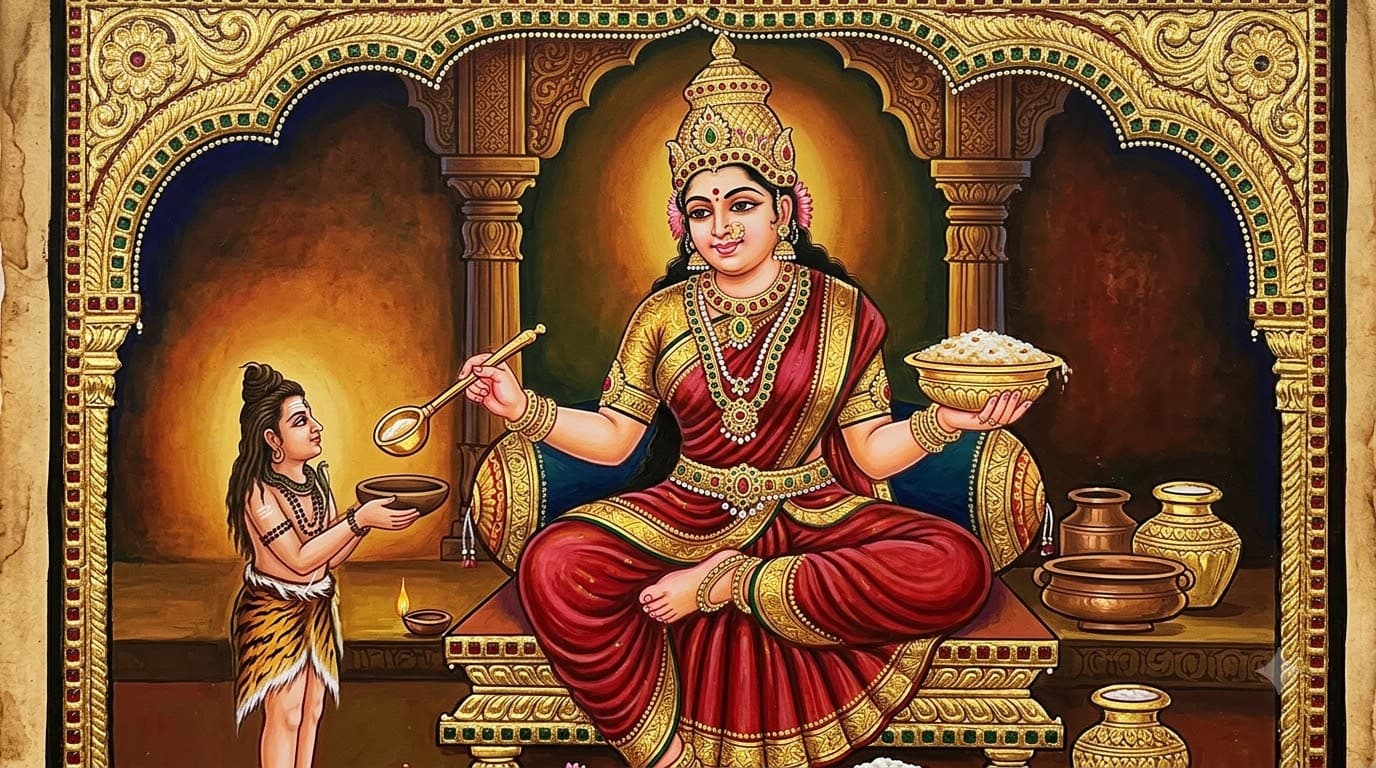
- Form: Seated, richly adorned, typically shown feeding Shiva, who approaches her as a mendicant with a begging bowl
- Known For: Feeding all creation from an inexhaustible golden ladle; presiding deity of the Annapurna temple in Kashi (Varanasi)
2. The Legend of Annapurna Devi
Tradition, drawn largely from the Kashi Khanda and the wider Shiva Purana tradition, holds that Shiva once dismissed the material world — including the need for food — as maya, an illusion beneath the notice of a true ascetic. To correct this, Parvati is said to have withdrawn herself from the world, and with her, all sustenance vanished, leaving even the heavens hungry. Humbled, Shiva is said to have arrived in Kashi as a mendicant, carrying a begging bowl, asking for alms.
There, Parvati is said to have manifested as Annapurna and fed him with her own hand from a golden ladle, teaching him that food itself is a form of the divine — "Annam Brahma," food is Brahman — and that even the greatest ascetic depends on the world's sustenance. The elders who retell this story usually frame it less as literal history and more as a teaching: renunciation and nourishment aren't opposites, and gratitude for a meal is its own kind of devotion.
3. Iconography & Symbolism
Annapurna Devi is generally depicted seated, richly dressed in red and gold, holding:
- A golden ladle: held in one hand, used to serve food — the central image of this form
- A bowl or vessel of rice or kheer: held in the other hand, said to never run empty
- Jeweled crown and full ornamentation: reflecting abundance rather than austerity
In many temple depictions and paintings, Shiva is shown standing before her with a begging bowl, receiving alms — the composition itself carries the legend, need meeting abundance in a single image.
4. When Is Annapurna Devi Worshipped in 2026?
In 2026, Annapurna Devi is worshipped on Wednesday, October 14, the fourth day of Navratri, corresponding to Ashwin Shukla Chaturthi. These dates follow the Telugu (Amanta) panchangam observed in Telangana and Andhra Pradesh, verified against a Hyderabad-set panchangam source rather than a generic or North-India-default one.
Panchangam Note: tithi-based observances are reckoned from local sunrise and can shift by a day between different panchangams, or for readers following the festival outside India. If you're timing a specific puja or sankalpam around Chaturthi, it's worth confirming the exact tithi window with a local panchangam or your pandit rather than relying on a single online source.
5. Spiritual Significance
Devotion to Annapurna Devi on this day is associated with gratitude for something ordinary enough to be taken for granted — a meal. Where the earlier days of Navratri build discipline and resolve, her day is often treated as a reminder that even the most devoted spiritual practice rests on the body being fed and cared for, not in spite of that need but through honoring it.
She is also closely associated, in belief, with generosity — the idea that feeding another person, even in a small way, is itself a form of worship. This is treated as a devotional practice rooted in tradition, not a rule with any fixed measure attached to it.
6. How to Worship Annapurna Devi at Home
A home puja for Annapurna Devi's day follows the same basic Navratri structure most households already have running, with a few specific touches:
- Clean the puja space and refresh the kalasham water and flowers as on previous days.
- Light a diya and offer kumkum and turmeric.
- Set aside the first portion of the day's cooked rice or a sweet dish as naivedyam before the family eats.
- Recite her dhyana shloka or listen to the Annapurna Stotram if your family follows one.
- If possible, mark the day with a small act of feeding someone — a family member, a helper, or someone in need.
7. Mantras & Chants
Annapurna Devi's most widely used beej mantra, used across Navratri puja guides, is:
"Om Annapoornayai Namah"
This is generally chanted 108 times using a japa mala. Some households also recite the Annapurna Stotram, a hymn traditionally attributed to Adi Shankaracharya that opens by invoking her as "Nityananda-kari" — the ever-blissful giver. If your family doesn't have a specific stotra passed down, a simple, sincere repetition of the beej mantra is considered sufficient.
8. Bhog & Naivedyam
Since Annapurna Devi is herself the goddess of food, her naivedyam tradition leans naturally toward rice-based offerings — a simple bowl of rice, a payasam, or whatever sweet the family typically prepares through Navratri. Many households treat this day as the right occasion for annadanam — donating or sharing a meal with someone in need — considering it the most meaningful offering of the day. As with the other days in this series, there isn't one fixed dish every Telugu household follows, so treat these as common conventions rather than strict rules.
9. Do's and Don'ts
Do:
- Avoid wasting food on this day, cooked or uncooked, in keeping with the spirit of the day.
- Set aside a portion of the day's food as naivedyam before the family eats.
- Consider a small act of sharing food with someone else, if it's within your means.
Don't:
- Don't treat annadanam as a mandatory ritual with a fixed measure — it's a devotional custom, not scripture.
- Don't skip verifying the Chaturthi tithi timing against a Hyderabad-set panchangam if you're planning a specific puja hour.
- Don't confuse Annapurna Devi with a general wealth goddess — her identity is specifically tied to food and nourishment.
10. Interesting Facts
- The Annapurna temple in Varanasi stands directly adjacent to the Kashi Vishwanath temple, and pilgrims commonly visit both together.
- Annapurna Devi has her own dedicated festival, Annapurna Jayanti, observed on Margashira Purnima — a separate occasion from Navratri.
- The Annapurna Stotram, attributed to Adi Shankaracharya, remains one of the most widely recited hymns dedicated to her.
- Most depictions show Shiva himself approaching her with a begging bowl — a reminder, in tradition, that all beings, divine or human, depend on food.
- Her worship during Navratri is one of the few centered explicitly on gratitude for something as ordinary and essential as a meal.
13. References & Further Reading
- Annapurna (goddess) — Wikipedia — background on her name, the Kashi legend, and her iconography.
- Navratri 2026 Date & Day 4, Hyderabad — DrikPanchang — the Hyderabad-specific panchangam source used for the 2026 date and tithi.
- Shaktism — Wikipedia — the wider Shakta tradition behind the forms of Devi worshipped across the festival calendar.
14. Final Thoughts
There's something quietly reassuring about a goddess whose defining act is feeding someone rather than fighting for them. Annapurna Devi's day sits right in the middle of the run-up to Navratri's more intense forms, and it works almost like a breath before the next stretch — a reminder that nourishment and generosity are their own kind of strength, not a lesser one.
Shubham.
Frequently Asked Questions
Q1. What is the meaning of the name Annapurna Devi?
Annapurna breaks down as "Anna" (food or grain) and "Purna" (full, complete). Together it reads as "she who is full of food," referring to her role in tradition as the goddess of nourishment.
Q2. When is Annapurna Devi worshipped in 2026?
Annapurna Devi is worshipped on Wednesday, October 14, 2026, the fourth day of Navratri, corresponding to Ashwin Shukla Chaturthi in the Telugu (Amanta) panchangam followed in Telangana and Andhra Pradesh.
Q3. What is the legend behind Annapurna Devi?
Tradition, drawn from the Kashi Khanda and the wider Shiva Purana, holds that when Shiva dismissed food as mere illusion, Parvati withdrew from the world and all sustenance vanished. She later manifested in Kashi as Annapurna and fed a humbled Shiva with her own hand, teaching that food itself is a form of the divine.
Q4. What does Annapurna Devi hold in her hands?
She is typically shown holding a golden ladle in one hand and a bowl or vessel of rice or kheer in the other, said to never run empty — the central image of her iconography.
Q5. Is offering food to others (annadanam) required on this day?
No. Sharing or donating a meal on this day is a widely followed devotional custom tied to Annapurna Devi's identity, but it isn't a strict rule with any fixed measure. Many households simply avoid wasting food and offer naivedyam as usual.
Q6. What is Annapurna Devi's beej mantra?
The widely used mantra is "Om Annapoornayai Namah," typically chanted 108 times with a japa mala as part of the day's puja.
Q7. Is Annapurna Devi the same as Lakshmi?
No. Both are associated with abundance, but they are distinct forms. Annapurna Devi's identity is specifically tied to food and nourishment, rooted in the Kashi tradition, while Lakshmi represents wealth and prosperity more broadly.
Q8. Can the Navratri dates shift by a day depending on the source I check?
Yes. Tithi-based dates are calculated from local sunrise and can shift by a day between panchangams or for readers outside India. It's worth confirming the exact date and time with a Telangana-set panchangam or your pandit before finalizing a puja.