Swarnakavacha Durga Devi: Navratri Day 1 2026 — Date & Puja Guide
By Divine center ·
Swarnakavacha Durga Devi opens Navratri on Ghatasthapana day. Here's her legend, iconography, the exact 2026 date for Telangana, and a simple home puja guide.
1. Who Is Swarnakavacha Durga Devi?
Swarnakavacha Durga Devi means, quite literally, "Durga in Golden Armor" — from Swarna (gold) and Kavacha (armor). It is the form invoked on the very first day of Navratri, when Durga is worshipped as an invincible protector, clad head to toe in gold — armor that stands for a strength nothing can pierce.
She is worshipped on Pratipada, the very first tithi of the bright fortnight of Ashwin, the same day households across Telangana perform Ghatasthapana — the installation of the sacred Kalasham that stays on the puja mandapam for the rest of Navratri.
At a Glance:
- Name meaning: Durga in Golden Armor (Swarna = gold, Kavacha = armor)
- Navratri day: Day 1
- 2026 date: Sunday, October 11, 2026
- Mount/vahana: Nandi, the bull
- Known for: Opening Navratri; representing invincible protection and the root strength the days that follow build on
2. The Legend of Swarnakavacha Durga Devi
Tradition holds that Swarnakavacha Durga Devi is worshipped as the rebirth of Sati, Shiva's first wife. The story, as it's passed down, tells of Sati immolating herself after her father Daksha insulted Shiva at a yagam Shiva was not even invited to. Devastated, Shiva is said to have wandered in grief until Sati was reborn as the daughter of Himavan and Menavati, named Parvati.
The Devi Mahatmyam and the broader Puranic tradition describe this rebirth as deliberate — a return specifically so she could win Shiva back as her husband, a task that, in later legends, becomes Bala Devi's long penance. Swarnakavacha Durga Devi, then, is the very beginning of that arc: the mountain's daughter, newly born, before the austerities and the marriage that follow in the stories of the days after hers.
3. Iconography & Symbolism
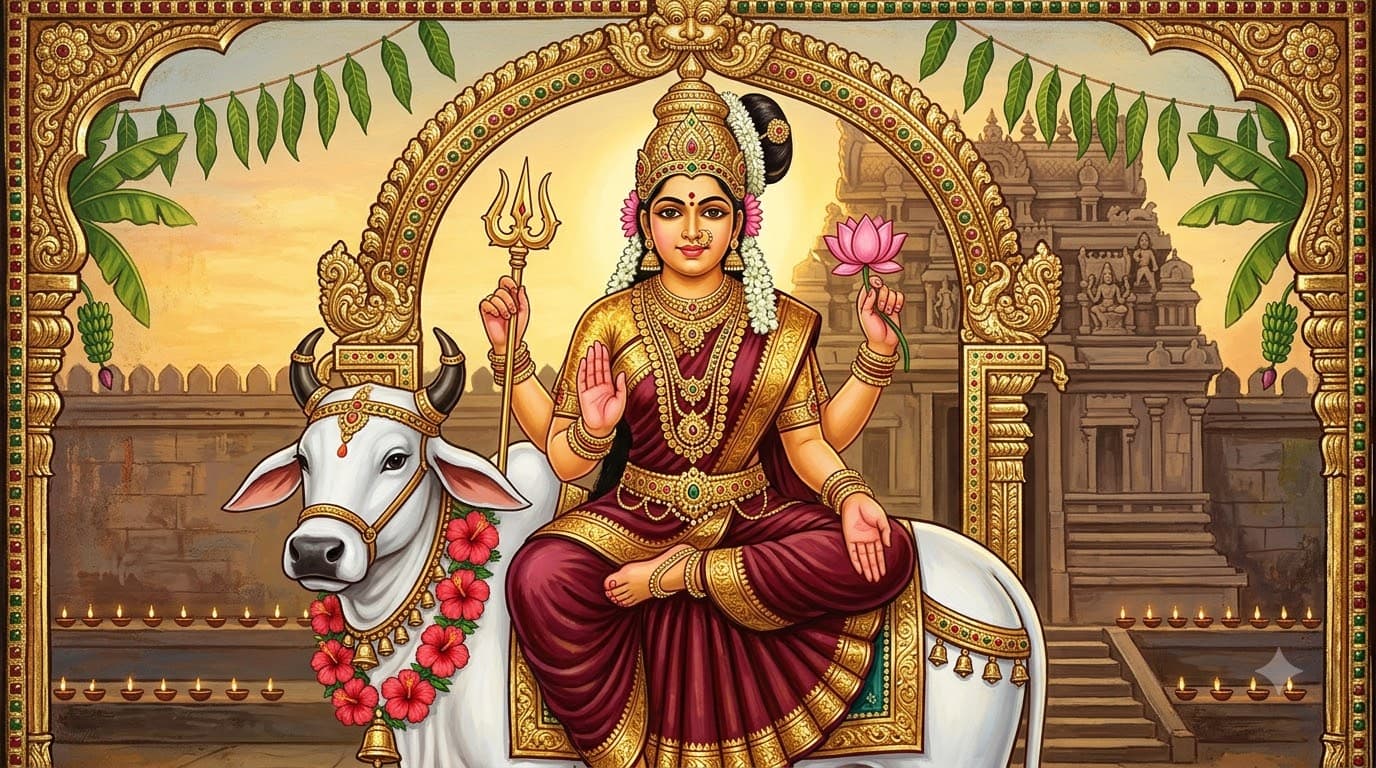
Swarnakavacha Durga Devi is shown seated on Nandi, Shiva's bull, which is part of why some households treat her form as a quiet nod to her eventual union with him even this early in the story. In her right hand she holds a trishul, and in her left, a lotus in full bloom.
- Nandi (the bull): her vahana, associated with steadiness, patient strength, and dharma
- Trishul (trident): the same weapon carried by Shiva, held here as a symbol of protection and readiness
- Lotus: held in a state of full bloom, representing purity and the auspiciousness of a new beginning
Taken together, tradition reads her as the embodiment of unbreakable protection — solid, gold-clad, and immense in a quiet way. She is described as the root energy the rest of Navratri is said to build on, which is part of why her day is treated as the necessary starting point for the festival.
4. When Is Swarnakavacha Durga Devi Worshipped in 2026?
Swarnakavacha Durga Devi is worshipped on Sunday, October 11, 2026, which falls on Ashwin Shukla Pratipada — the first tithi of Navratri, and the same day as Ghatasthapana, the Kalasham installation that formally opens the nine nights.
These dates follow the Telugu (Amanta) panchangam observed in Telangana and Andhra Pradesh.
Panchangam Note: Tithi-based observances are reckoned from local sunrise and can shift by a day between panchangams, or for readers outside India. It's worth confirming the exact Ghatasthapana muhurtam with a local panchangam or your pandit before fixing your puja timing.
5. Spiritual Significance
Devotion to Swarnakavacha Durga Devi on the first day is traditionally believed to build stability — a settled mind and a steady base — before the more demanding forms of the goddess that follow through the week. Since the other eight forms of Navadurga are said to grow out of her, worshipping her first is treated less as a separate act of devotion and more as laying the ground the rest of Navratri stands on.
Many households connect this protective quality directly to the gold-armor imagery in her name — the idea that real strength, like armor, doesn't need to be loud to be impenetrable.
6. How to Worship Swarnakavacha Durga Devi at Home
Because Swarnakavacha Durga Devi's day coincides with Ghatasthapana, most households fold her worship directly into the Kalasham installation rather than treating it as a separate puja:
- Ghatasthapana: clean the puja space, place a Kalasham filled with water, and set it on a bed of rice or soil where nine varieties of grain are sown
- Sankalpam: state your intention for observing Navratri, addressed to Swarnakavacha Durga Devi as the presiding form for the day
- Invocation: offer akshatalu, kumkum, turmeric, and a white or light-colored flower where possible, since white is one of the colors popularly associated with her form
- Harati: conclude with a simple harati and share prasadam with the family
A pandit is often called specifically for the Ghatasthapana sankalpam and muhurtam, since getting the timing and the mantras right on this first day is considered important for how the rest of Navratri proceeds.
7. Mantras & Chants
There isn't a separately established beej mantra specific to the temple alankaram name Swarnakavacha Durga Devi — it is a decorative form of Durga rather than a distinct deity with her own scriptural mantra. Households worshipping this form on Day 1 typically use the general Durga beej mantra:
"Om Hreem Durgayai Namah"
Alongside this, households commonly recite the Navadurga Stotra or Durga Saptashati verses appropriate to the first day of Navratri. If you're unsure of the exact Sanskrit for a longer stotra, it's better to have a pandit lead the chanting than to attempt an unfamiliar verse from memory.
8. Bhog & Naivedyam
A commonly cited tradition associates Swarnakavacha Durga Devi's day with an offering of pure ghee (ghee/neyyi), believed to support health and reduce the risk of illness through the coming year. Beyond this, most Telugu households simply offer whatever satvik naivedyam — fruits, panchamritam, or a simple sweet — they prepare for the Kalasham each day of Navratri, rather than following one fixed recipe specific to her form.
9. Do's and Don'ts
Do:
- Complete Ghatasthapana within the correct muhurtam for the day, ideally guided by a pandit or a Hyderabad-set panchangam.
- Keep the Kalasham undisturbed in its place through all nine days once it's installed.
- Light a diya near the Kalasham each morning and evening through Navratri.
Don't:
- Don't move or relocate the Kalasham once Ghatasthapana is complete.
- Don't treat the color and mantra conventions circulating online as fixed scripture — they're popular conventions, not settled rules.
- Don't skip confirming the Pratipada tithi timing if you're planning the sankalpam for a specific hour.
10. Interesting Facts
- Swarnakavacha Durga Devi is the only Day 1 form whose worship is inseparable from a second major ritual — Ghatasthapana — happening at the same time.
- Her mount, Nandi, is otherwise most closely associated with Shiva, a detail many read as foreshadowing her eventual marriage to him.
- White is one of the colors popularly associated with her day in modern Navratri color charts, though this convention varies from list to list and isn't scriptural.
- Tradition holds she is Sati reborn — making her, in a sense, the same soul that later becomes Bala Devi's penance and Parvati's marriage to Shiva.
13. References & Further Reading
- Navadurga — Wikipedia — background on the Puranic tradition behind the nine forms of Durga worshipped across Navratri, including the gold-armored form honored on Day 1.
- Navratri 2026 Date & Time, Hyderabad — DrikPanchang — the Hyderabad-specific panchangam source used for this year's Ghatasthapana and Pratipada timing.
- Navadurga — Wikipedia — overview of all nine forms of Durga worshipped across Navratri.
14. Final Thoughts
There's something fitting about starting Navratri with a form of the goddess clad in armor that cannot be broken — nine days of festivity, music, and elaborate ritual all resting, in the end, on one quiet, steady, protected beginning. Whatever your Ghatasthapana looks like this year, big or small, it's the same first step families have been taking on this day for generations.
Shubham.
Frequently Asked Questions
Q1. What does the name Swarnakavacha Durga Devi mean?
Swarnakavacha Durga Devi means "Durga in Golden Armor," combining Swarna (gold) and Kavacha (armor). It describes the form in which Durga is worshipped on the first day of Navratri, clad in gold armor as an invincible protector.
Q2. When is Swarnakavacha Durga Devi worshipped in 2026?
Swarnakavacha Durga Devi is worshipped on Sunday, October 11, 2026, which is Ashwin Shukla Pratipada, the first day of Navratri and the day Ghatasthapana is performed, per the Telugu (Amanta) panchangam followed in Telangana.
Q3. Is Swarnakavacha Durga Devi a separate goddess from Durga?
No — she is a specific gold-armored form in which Durga is adorned and worshipped on Day 1 of Navratri, not a separate deity. The name describes the alankaram (adornment) rather than a distinct identity.
Q4. Why is Ghatasthapana performed on this day?
Ghatasthapana, the installation of the sacred Kalasham that opens Navratri, falls on Ashwin Shukla Pratipada — the same tithi on which Durga is worshipped as Swarnakavacha Durga Devi. Her worship and the start of the festival are treated as one combined observance.
Q5. What does Swarnakavacha Durga Devi hold, and what does it mean?
She is depicted riding Nandi the bull, holding a trishul (trident) in her right hand and a lotus in full bloom in her left. Tradition reads these as symbols of protection, readiness, and purity respectively.
Q6. Is there a specific mantra for Swarnakavacha Durga Devi?
There isn't a separate scriptural beej mantra tied to this alankaram name specifically. Households commonly use the general Durga mantra "Om Hreem Durgayai Namah" and recite Navadurga Stotra verses appropriate to Day 1 during her puja.
Q7. What should be offered as bhog on this day?
A commonly cited tradition is offering pure ghee on Day 1, believed to support health and reduce the risk of illness through the coming year. Beyond this, most Telugu households simply offer whatever satvik naivedyam — fruits, panchamritam, or a simple sweet — they prepare for the Kalasham each day of Navratri.
Q8. Do the Navratri color-of-the-day charts apply to this form?
White is commonly listed for Day 1 in popular Navratri color charts, but these lists are a modern media convention that varies between sources, not a scriptural rule — worth treating as a suggestion rather than a fixed requirement.